

Table of Contents
The Stone Sanctuary: French Abbeys and the Forging of a Visual Civilization
The French abbey stands as one of the most potent and enduring symbols of medieval European civilization. More than mere monasteries, these complexes were powerhouses of faith, learning, agriculture, and—critically—artistic production. The relationship between French abbeys and art is not merely one of patronage but of genesis; the cloister was often the cradle, the scriptorium the workshop, and the divine liturgy the muse. From the stark grandeur of Romanesque austerity to the heavenly ascent of Gothic luminosity, the artistic output of French abbeys charted the spiritual and intellectual contours of a nation and shaped the very trajectory of Western art.
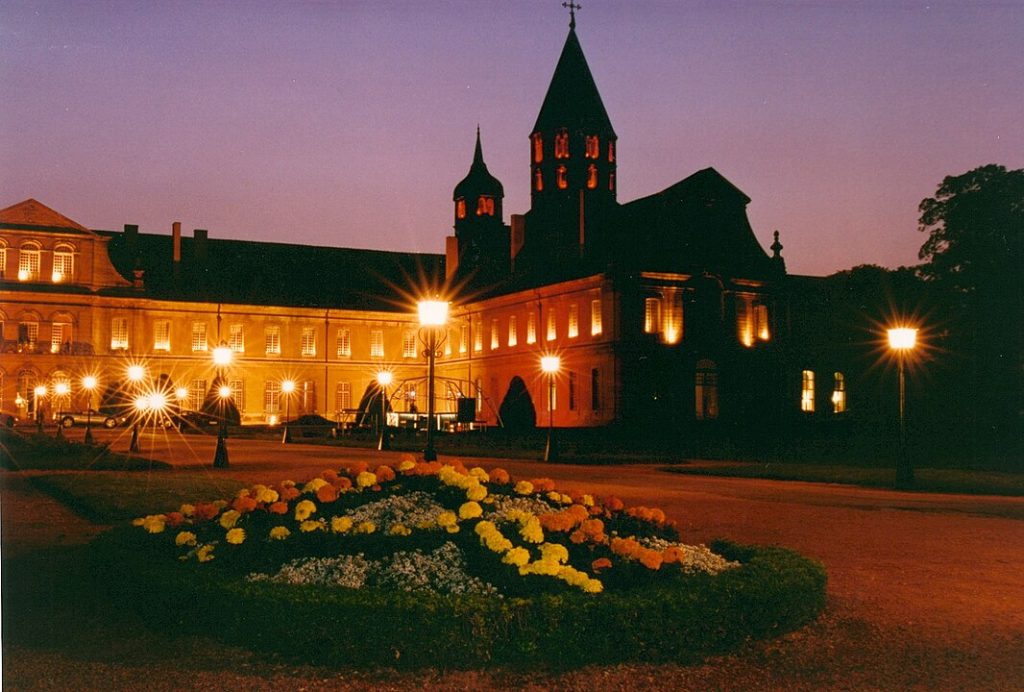
Image: By No machine-readable author provided. Calyps~commonswiki assumed (based on copyright claims). – No machine-readable source provided. Own work assumed (based on copyright claims)., CC BY-SA 2.5, https://commons.wikimedia.org/w/index.php?curid=517657
I. The Theological Foundation: Art as Didactic and Contemplative Tool
To understand the artistic fervor of the abbeys, one must first grasp their theological worldview. The dominant monastic rule in France, the Rule of Saint Benedict (c. 480–547), prescribed a life of prayer, work, and study (ora et labora). Art served both the ora (prayer) and the labora (work). In an era of widespread illiteracy, visual art became the “Bible of the illiterate” (Biblia pauperum), teaching scripture and doctrine through narrative.
Furthermore, following the theological rationale of figures like St. Bernard of Clairvaux and the influential Abbot Suger of Saint-Denis, beauty was not a distraction but a pathway. Material splendor, if properly ordered, could elevate the soul from the material to the immaterial, from the sensory to the divine. The abbey church, as the “Heavenly Jerusalem on earth,” had to manifest this sublime order through architecture, sculpture, and light.
II. Architectural Evolution: From Romanesque Fortress to Gothic Symphony
The abbey church is the central artistic statement, and its evolution in France is a master narrative of medieval art.
- Romanesque (10th–12th Centuries): The Architecture of Solidity and Fear.
Exemplified by abbeys like Cluny III (the largest church in Christendom until St. Peter’s) and the still-majestic Abbaye de Fontenay, Romanesque architecture expressed monastic ideals of permanence, separation from the world, and awe. Characteristics included:- Massive Stone Walls: Conveying fortress-like security and spiritual refuge.
- Barrel and Groin Vaults: Replacing flammable wooden roofs, creating a somber, cavernous interior atmosphere.
- Round Arches and Robust Piers: Emphasizing earth-bound solidity.
- Limited Windows: Rendering interiors dark, mysterious, and focused inward on the altar. The artistic effect was one of overwhelming power and solemnity, directing the monk’s mind to the gravity of God’s majesty and judgment.
- Gothic (12th–16th Centuries): The Architecture of Light and Ascent.
Sparked by the rebuilding of the Royal Abbey of Saint-Denis under Abbot Suger (1140s), Gothic architecture became a theological revolution in stone. Suger believed light was the physical manifestation of the Divine. Key innovations included:- The Pointed Arch and Rib Vault: Distributing weight more efficiently.
- The Flying Buttress: Exterior supports that allowed walls to become skeletal frameworks.
- The Triumph of Stained Glass: Walls were replaced by vast windows of colored light, as seen in the stunning Sainte-Chapelle (a royal chapel built to abbey-like proportions). The narrative cycles in glass, like those at Chartres Cathedral (deeply connected to the monastic school), bathed the interior in a luminous, symbolic radiance. Gothic abbeys like Saint-Denis (the necropolis of French kings) and Mont-Saint-Michel (a vertiginous marvel on the sea) aimed not to humble but to elevate, drawing the worshipper’s eye and spirit heavenward.
III. The Cloister and Capital: Sculpture as Spiritual Encyclopedia
If the church aimed for the heavens, the cloister—the covered walkway around a square garden—was the heart of monastic life and a gallery of Romanesque sculpture. Here, narrative and symbolism flourished on historiated capitals. The Cloister of Moissac (c. 1100) offers one of France’s most spectacular examples. Its piers and capitals are carved with profound complexity: scenes from the Life of Christ, the Apocalypse, intertwined beasts, and foliate designs.
Each capital was a meditation piece for the strolling monk, a visual sermon on virtue, vice, and sacred history. The terrifying tympanum of the Last Judgment at the cloister’s entrance served as an eternal reminder of monastic purpose. This sculptural program transformed the cloister into a three-dimensional textbook of theology and morality.
IV. The Scriptorium: The Art of the Illuminated Word
The monastic scriptorium was the chief center of book production before the rise of universities. Here, the art of illumination reached astonishing heights. French abbeys were famed for their manuscripts:
- The Carolingian Renaissance: Abbeys like Saint-Martin de Tours and Reims produced masterpieces such as the Utrecht Psalter, with its vibrant, kinetic ink drawings that breathed new life into classical models.
- The Romanesque Period: The Abbey of Citeaux, motherhouse of the Cistercian order, initially produced austerely beautiful but mostly unillustrated texts in line with St. Bernard’s critique of distracting ornament. Yet, other scriptoria, like that at Cluny, created richly illuminated liturgical books.
- The Gothic Period: Production shifted increasingly to urban workshops, but monastic foundations remained vital patrons. The *Très Riches Heures du Duc de Berry (c. 1410), while made for a noble, was created by the Limbourg brothers, whose art was deeply rooted in the Gothic International style nurtured in monastic and court contexts. These manuscripts married text and image in a sacred dance, making the Word resplendent.
V. The Cistercian Exception: Aesthetic of Purified Form
No discussion of French abbeys and art is complete without the Cistercian reform. St. Bernard of Clairvaux, in reaction to Cluniac opulence, demanded stark simplicity. The architecture of abbeys like Fontenay and Le Thoronet became an art form in its own right through pure geometry, exquisite stonework, and masterful acoustics. Decoration was banned: no figured capitals, no stained glass, no towers. The art was in the proportions, the play of light on unadorned stone, and the functional elegance of the space. This “aesthetic of austerity” became one of the most powerful artistic statements of the Middle Ages, proving that supreme artistry could reside in restraint and harmony.
VI. Legacy and Ruin: From Revolution to Romanticism and Beyond
The French Revolution dealt a catastrophic blow to the monastic system. Abbeys were nationalized, dissolved, and often sold as quarries for stone. The majestic ruins of Cluny or Jumièges became, in the 19th century, potent symbols for the Romantics—emblems of a lost spiritual unity and the sublime power of decay. This very ruin sparked a preservation movement led by figures like Viollet-le-Duc, who restored Mont-Saint-Michel and Vézelay (a monastic church).
Today, these abbeys, whether active like Solesmes (a global center for Gregorian chant) or preserved as “Historic Monuments,” are recognized as UNESCO World Heritage sites. They are not merely museums but living repositories of a collective memory, where the stone, glass, and carved foliage continue to speak of an age when faith commissioned a visual symphony.
Conclusion
The French abbey was the nexus where spiritual aspiration met artistic genius. Its walls framed a total work of art (Gesamtkunstwerk) encompassing architecture, sculpture, painting, stained glass, metalwork, and music. From the apocalyptic visions carved at Moissac to the celestial light pouring into Saint-Denis, French monastic art did more than decorate; it sought to materialize the metaphysical. It was an art ordered toward transcendence, a stone and glass testament to the belief that beauty was a path to truth. In studying these sanctuaries, we thus read not only the history of French art but also the evolving aspirations of the human spirit in its quest for the divine.

No responses yet