
Table of Contents
Beyond the Image: Decoding the Visual Language of Islam
To walk through the Alhambra’s hushed courtyards or open a page of an illuminated Qur’an is to enter a world governed by a sophisticated visual code. It is a language that speaks not through the human figure, but through the infinite modulation of geometry, the verdant curl of the arabesque, and the disciplined, majestic flow of calligraphy. For a Western gaze, trained by the Renaissance to expect narrative through corporeal form—the weeping Madonna, the crucified Christ, the heroic nude—this art can seem at first like an art of pure absence, a refusal. But this is a profound misreading. The visual code of Islam is not an art of denial, but of affirmation, a conceptual toolkit designed to translate the central, radical tenet of tawhid, the absolute and indivisible oneness of God, into a direct, sensory experience. To decode this visual language is to understand how a faith built a universe of meaning without the image, turning abstraction into the most intimate portrait of the divine.
The Theological Foundation: Aniconism as a Creative Constraint
The entire edifice of Islamic visual culture rests on a theological principle often misunderstood: aniconism, the avoidance of figural imagery in religious contexts. It is crucial to state this clearly at the outset—there is no single, explicit verse in the Qur’an that commands, “Thou shalt not make images,” as in the biblical Decalogue. The prohibition is derived from the Hadith, the collected sayings and actions of the Prophet Muhammad, where the creation of living forms is seen as a presumptuous act, a mimicking of God’s unique creative power. The artist, in fashioning a human or animal, is thought to be challenging the sole prerogative of the al-Musawwir, the Fashioner, one of the ninety-nine Beautiful Names of God. On the Day of Judgment, a maker of images will be challenged to breathe life into his creation, and his inevitable failure will be his punishment.
This theological stance was not a dead end but a creative catalyst of immense power. It imposed a supreme discipline that forced artists, architects, and craftsmen away from the mimicry of the physical world and toward the exploration of the underlying intellectual and spiritual principles of reality. By abandoning the singular, dominating focal point of the human figure—the icon, the statue, the altarpiece—Islamic art opened itself to a boundless field of visual inquiry. The constraint was the gateway to a profoundly democratic and unified aesthetic. The eye is not commanded to venerate a specific holy body; instead, it is liberated to wander across a continuous, infinite field of pattern that implies a single, divine source code running through all creation. This is the key that unlocks the entire visual code: the medium is the message of unity.
The Primacy of the Word: Calligraphy as Sacred Geometry
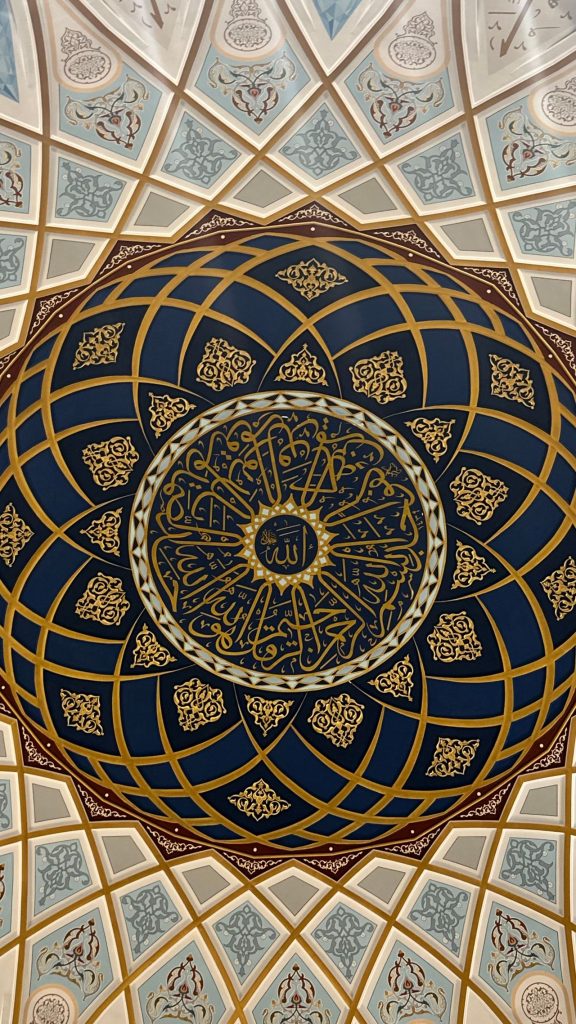
Within this code, the written word does not merely describe the sacred; it is the sacred’s primary material embodiment. This is the crowning art form of Islamic civilization because the Qur’an is not considered a book inspired by God, but God’s literal, uncreated speech revealed in the Arabic language. To write the Word of God, then, is an act of the highest devotion. Calligraphy is not decorative writing; it is a sacred geometry of the soul, a visual music that gives the divine revelation a body of ink and gold fit for its eternal nature. The calligrapher’s reed pen becomes an instrument for channeling divine beauty, governed by a strict, mathematically precise system of proportions. Each letter of the Arabic alphabet has a specific module, based on the rhombic dot created by a single touch of the pen, which dictates its height, curve, and relationship to every other letter.
This rigorous intellectual and spiritual discipline gave rise to a dazzling spectrum of scripts, each with its own visual personality and liturgical function. The stately, angular Kufic, with its horizontal stretches and vertical sword-strokes, conveys a sense of austere, monumental power, perfect for the architecture of the early Qur’an. Its letters feel hewn from light and stone. In contrast, the fluid, cursive scripts like Thuluth, with its dramatic ascenders and deep, sweeping curves, became the script of architectural grandeur, wrapping the interiors of mosques in a flowing ribbon of meaning. The sinuous Nasta’liq, described by its masters as “a bride, her hair flowing,” carries the lyrical poetry of Hafez and Rumi. The text is never just read; it is seen, felt, and encountered. It can fracture into mirror-image doubles, intertwine into complex knots, or be adorned with a subtle crown of flowers, all while remaining legible to the initiated. It is a code within a code, a celebration of the container as much as the content, reminding the viewer that a divine message demands a divine vessel.
The Infinite Pattern: Geometry and the Order of the Cosmos
If calligraphy is the visual voice of God, geometry is the visual proof. The intricate, star-studded geometric patterns that adorn everything from grand mosque domes to a simple brass bowl are not mere “decoration” in the modern, trivial sense of the word. They are a philosophical argument made visible. These patterns are constructed from a few simple, universal tools—the compass and the straightedge—and a single starting point: the circle. The circle, a shape with no beginning and no end, is a fundamental symbol of divine unity and the eternal, indivisible oneness of tawhid. From this circle, by dividing its circumference, the triangle, the square, the pentagon, and the hexagon are born in a silent, mathematical genesis. These regular polygons then multiply, rotate, and interlace into the eight-pointed star, the twelve-pointed star, and onwards into mind-bending complexity.
The visual experience is one of controlled infinity. The pattern, governed by an underlying, invisible grid, suggests it could expand beyond its physical frame, radiating outward forever across the surface of the world. This dissolution of a central focus is key. There is no “main part” of a geometric zellige tile wall; every tile is as important as every other. The human eye is guided on a non-hierarchical journey, tracing lines of connection and unity. In this, we find a direct aesthetic translation of the Islamic conception of God’s relationship to the cosmos: an infinite, all-pervasive presence that is everywhere a center. The complex patterns are a cognitive workout, a visual dhikr, or remembrance, that pulls the mind from the transient and material toward the permanent and abstract order underpinning all existence. The artisan who carved the plaster or laid the tile was not just making a beautiful room; they were constructing a model of a divinely ordered universe where multiplicity resolves into absolute unity.
The Subdued Garden: The Arabesque and the Promise of Paradise
Flowing alongside and weaving through the geometric armature is the arabesque, the stylized, scrolling vine that is the organic half of this visual code. The arabesque is not a botanical illustration; it is a perfect synthesis of the natural world and geometric discipline. Its leaves, flowers, and tendrils grow not according to the laws of photosynthesis but to a rhythm of mathematical symmetry and rhythmic repetition. A central stem spirals outward, sending off branches that curl back upon themselves in a continuous, balanced flow, often obeying a strict bilaterally symmetrical design. This is nature perfected, tamed, and eternalized, freed from the real-world cycles of decay and death.
The symbolic resonance of the arabesque operates on multiple levels. On one hand, it is a direct visual echo of the lush, paradisal gardens described in the Qur’an—Gardens of Eden beneath which rivers flow, a place of perpetual shade, cool water, and eternal bloom. In the harsh, arid landscapes of much of the early Islamic world, the vision of a verdant, water-filled garden was the ultimate image of divine reward. On a deeper philosophical level, the arabesque’s unending, self-perpetuating scroll is another metaphor for the infinite nature of divine creation, a creation that is not a single, historical event but a continuous, ever-unfolding effusion. Crucially, the arabesque often plays with the tension between figure and ground, between the solid form of the vine and the empty space it carves out. In a masterful arabesque, you cannot tell which is foreground and which is background; the pattern becomes an impossible, rhythmic oscillation of positive and negative. This visual shimmer is the final dissolution of material solidity, a hint that everything we see is but a fleeting, intertwined veil.
The Architecture of Light: The Mosque as Coded Space
These elements—the word, the geometric proof, the stylized vine—do not exist in isolation. They are woven together into a total, immersive environment, most perfectly realized in the architecture of the mosque. Unlike a Gothic cathedral, which uses its structural logic of pointed arches and flying buttresses to pull the eye relentlessly upward along a single vertical axis toward a point of light, the classical mosque operates on a different principle: horizontal expansion and the dissolution of mass. The hypostyle hall, a forest of columns and arches, creates a sense of spatial infinity. The eye cannot grasp the whole room; it moves from column to column, bay to bay, in a rhythmic, repeating sequence that mirrors the prayer rows of the faithful. There is no central sacred object, no altar with a relic. The focal point, the mihrab niche, is an empty void, a prayer direction marked not by a statue but by concentrated ornament, a directional sign of pure light and pattern.
Light here is not a symbol of divine presence; it is itself presented as the divine presence. The Qur’anic verse from the Surah An-Nur, inscribed on countless mosque lamps and walls, is the literal script for this architectural drama: “God is the Light of the heavens and the earth. The parable of His Light is as if there were a Niche and within it a Lamp: the Lamp enclosed in Glass: the glass as it were a brilliant star.” The architecture physically performs this verse. Sunlight is filtered through pierced stucco screens, dissolving solid walls into shimmering, weightless membranes. It glances off glazed ceramic tiles, making the geometric patterns seem to float in an underwater dimness. It drips from hanging glass lamps, each one a tiny sun. The architecture of the mosque is designed not just to house the faithful, but to dematerialize the stone and create an experience of the Divine Light spoken of in the text, transforming a building into a prayer.
The Secular Sphere: The Code in the Court
To assume this visual code was purely for the mosque is to miss its profound cultural penetration. It was, and remains, a complete aesthetic universe that extended into the secular sphere, blurring the lines between sacred and profane in a way that reflects a holistic worldview. The same geometric rigor that orders a Qur’an page gives dignity to a humble ceramic bowl. The arabesque that promises paradise on a prayer rug’s border brings a micro-version of that promise to a silk robe. The royal miniatures of the Persian and Mughal courts—where figural painting did historically flourish, creating a glorious “exception” that proves the rule—are still governed by this code. Their flat, jewel-like color, lack of single-point perspective and shadow, and intricate borders of geometry and arabesque frame the narrative scene not as a window into the physical world, but as a precious, imagined vision on a decorated page. The visual code of Islam, therefore, is not merely a set of religious prohibitions. It is a comprehensive language for seeing the world as it truly is, beneath its material surface: a tissue of harmonious, interconnected, and meaningful signs pointing to a single, ineffable, and unified source.


No responses yet