
The Mandala: A Sacred Geometry of Enlightenment in Buddhist Art
Table of Contents
I. Introduction: The Universe in a Circle
The mandala, a Sanskrit word meaning “circle” or “discoid object,” is one of the most profound and visually captivating artistic expressions in Buddhist traditions. More than mere decoration, a mandala is a cosmic diagram, a sacred microcosm of the universe, and a meticulously crafted tool for meditation, ritual, and spiritual transformation. From the intricate sand paintings of Tibetan monks to the towering architectural temples of Borobudur, mandalas serve as bridges between the material and spiritual realms, guiding practitioners on a symbolic journey from the periphery of ordinary existence to the enlightened center of ultimate reality.
This essay explores the historical origins, symbolic architecture, varied forms, ritualistic creation, and enduring philosophical significance of Buddhist mandala art.
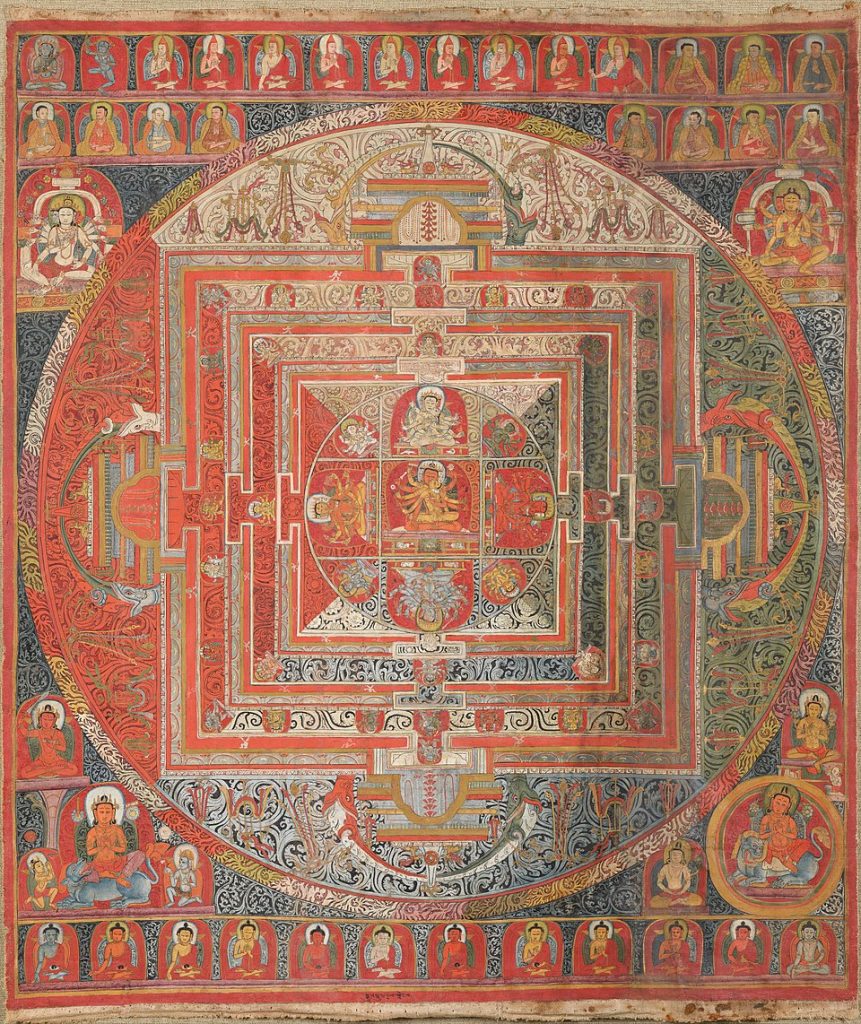
Image: By Unknown author – Google Cultural Institute, Public Domain, https://commons.wikimedia.org/w/index.php?curid=35352478
II. Historical Origins and Evolution
The concept of the mandala predates Buddhism, appearing in ancient Hindu texts like the Rigveda to describe ritualistic and cosmic structures. However, Buddhism, particularly in its Vajrayana (Tibetan) and Esoteric (Shingon) branches, elevated the mandala to a central theological and artistic complex.
- Early Foundations: Simple circular motifs appeared in early Buddhist art in India, but the structured, geometric mandala gained prominence with the rise of Mahayana Buddhism (c. 1st century BCE onward) and the development of Tantric Buddhism (c. 5th century CE onward). Tantric texts (tantras) outlined detailed visualizations of Buddha-fields and deities, requiring systematic representation.
- Transmission Across Asia: As Buddhism spread, the mandala adapted to local cultures. It traveled from India to:
- Tibet: Where it became the cornerstone of monastic art and practice, culminating in the exquisite but ephemeral sand mandala.
- Nepal, Bhutan, and Mongolia: Where similar Tibetan traditions flourished in thangka paintings (scrolls) and temple murals.
- China and Japan: In Chinese Esoteric Buddhism and Japanese Shingon Buddhism, mandalas like the Taizokai (Womb Realm) and Kongokai (Diamond Realm) became central to practice.
- Southeast Asia: The very architecture of temples like Cambodia’s Angkor Wat or Java’s Borobudur can be interpreted as three-dimensional mandalas, mapping the cosmos in stone.
III. Symbolic Architecture: Anatomy of a Mandala
Every element in a classical Buddhist mandala is laden with symbolism, creating a multi-layered spiritual map.
- The Outer Circle – Enclosure: Often depicted as a ring of fire, it represents the burning away of ignorance and the boundary between the sacred space and the profane world.
- The Square Palace – Sacred Architecture: Within the circle lies a square structure with four elaborate gates facing the cardinal directions. This is the palace of the deities, representing a perfected Buddha-field. The gates are guarded by protectors and symbolize the four boundless thoughts: loving-kindness, compassion, sympathetic joy, and equanimity. They invite the practitioner to enter.
- The Central Axis – Mount Meru: At the very center lies the central deity, the embodiment of enlightenment or a specific Buddha-quality (like compassion for Avalokiteshvara or wisdom for Manjushri). This center corresponds to Mount Meru, the axis mundi of Buddhist cosmology, connecting earthly and celestial realms.
- Concentric Circles – Paths and Realms: Between the gates and the center are often concentric circles that may depict lotus petals (symbolizing purity), vajras (symbolizing indestructible reality and skillful means), or cemeteries (representing the impermanence of the ego). These are the realms or stages the meditator traverses inward.
- Color Symbolism: Colors are not arbitrary. Typically, the five central colors (white, yellow, red, green, blue) correspond to the Five Wisdom Buddhas, the five psychic poisons they transform, and the five elements.
IV. Diverse Forms and Manifestations
The mandala principle manifests in various artistic mediums, each with its own purpose.
- Sand Mandalas (Tibetan: dul-tson-kyil-khor): The most iconic and transient form. Created over days or weeks by teams of monks using metal funnels (chak-pur), these are intricate works of millions of colored sand grains. Their deliberate destruction after completion is a profound lesson in non-attachment and impermanence (anicca).
- Painted Mandalas (Thangkas and Murals): Painted on cloth scrolls (thangkas) or temple walls, these permanent mandalas serve as objects of contemplation, teaching tools, and focal points for visualization practices.
- Three-Dimensional Mandalas: These include ritual bronze or wood sculptures (mandala plates), temple architectures (like the mandala of a stupa or the layout of a Tibetan temple complex), and even ritual dances (Cham) where monks embody the deities of the mandala.
- Meditation Mandalas: Simple line drawings, sometimes called yantras, used by individual practitioners to focus the mind during visualization exercises.
V. The Ritual of Creation and the Path of Meditation
The creation and use of a mandala is a sacred ritual, not an artistic hobby. The process is as important as the product.
- Consecration and Preparation: The site is purified, prayers are offered, and the design is often transferred from memory or sacred texts. The artists/monks enter a state of meditation.
- The Process as Practice: Every grain of sand placed is an act of mindfulness, devotion, and visualization. The monks channel the deities they are depicting, believing the mandala becomes inhabited by the divine presence.
- The Meditative Journey: For a practitioner, the mandala is a guided path. Meditation begins at the outer gate. The practitioner visualizes entering, moving past symbolic obstacles, dissolving their ego, and ultimately merging with the central deity—the essence of enlightenment within. This inward journey represents the transformation from confusion to wisdom.
- Dissolution – The Ultimate Teaching: The ritual dismantling of the sand mandala is its most powerful aspect. The sand is swept up, symbolizing the deconstruction of the perfected world, and poured into a body of water to bless the wider world. This act viscerally demonstrates the core Buddhist truth that all compounded things are impermanent, and that non-attachment is the key to liberation.
VI. Philosophical and Psychological Significance
Beyond ritual, the mandala embodies deep philosophical principles.
- A Model of the Mind and Cosmos: The mandala is a macrocosm-microcosm equivalence. It represents both the outer universe and the inner universe of the practitioner’s mind. The palace is not somewhere else; it is the pure nature of one’s own awareness.
- Integration of Opposites: The symmetrical, geometric order of the mandala represents the harmony and balance of enlightenment. It integrates male and female principles (method and wisdom), the worldly and the transcendent, and chaos (the outer fire) with perfect order (the inner palace).
- Jungian Interpretation: Swiss psychiatrist Carl Jung saw mandalas as archetypal symbols of the Self, representing the human psyche’s innate drive toward wholeness and individuation. He observed that people across cultures spontaneously draw mandala-like forms during times of personal growth or psychological distress, suggesting a deep, universal resonance.
VII. Conclusion: An Enduring Symbol for a Modern World
In an age of fragmentation and distraction, the Buddhist mandala continues to offer a powerful vision of wholeness, purpose, and peace. It is a testament to the human capacity to seek order within chaos, meaning within form, and the sacred within the mundane.
Whether encountered in a museum, a temple, or a digital visualization, the mandala invites us on a journey—not to a distant heaven, but to the profound center of our own being. It teaches that enlightenment is not a far-off destination but a latent potential, systematically accessible through discipline, compassion, and wisdom, mapped out in breathtaking artistry as a guide for all who wish to make the inward journey. In its exquisite balance of form and void, creation and dissolution, the mandala remains one of humanity’s most profound artistic and spiritual achievements.

One response
hello world
hello world