

Table of Contents
The Art of Edward Hopper: An Essay on Light, Silence, and the American Soul
Edward Hopper (1882–1967) stands as one of the most significant figures in 20th-century American art, a quiet observer whose paintings have become iconic symbols of modern life’s undercurrents. In an era that witnessed the birth of abstraction, surrealism, and conceptual art, Hopper remained steadfastly committed to representational painting. Yet, to call him simply a “realist” is to miss the profound psychological depth of his work. His art captures not merely the appearance of America—its diners, gas stations, and lonely apartments—but its inner life: a pervasive sense of solitude, introspection, and the quiet drama of everyday existence. This essay explores Hopper’s artistic journey, his signature themes, and the refined techniques that make his work a timeless meditation on the human condition.
From Nyack to New York: The Formation of an Artist
Edward Hopper was born on July 22, 1882, in Nyack, New York, a Hudson River town where his middle-class family nurtured his early artistic talent. His training at the New York School of Art brought him under the tutelage of influential teachers like William Merritt Chase and Robert Henri. Henri, in particular, urged his students to paint what interested them in life and to “make a stir in the world,” a lesson Hopper internalized by turning to distinctly American subjects rather than imitating European fashions.
After completing his formal studies, Hopper took a path common to artists seeking to deepen their understanding: he traveled to Europe. Between 1906 and 1910, he visited Paris three times, absorbing the work of the Impressionists. However, unlike many of his contemporaries who were seduced by Cubism, Hopper claimed he hadn’t “even heard of Picasso.” He was instead drawn to the handling of light in Rembrandt and the moody, atmospheric cityscapes of etchers like Charles Méryon. This European sojourn did not turn him into a radical modernist in technique, but it sharpened his eye for the poetic potential of light and shadow—an element that would become the cornerstone of his mature style.
Returning to America, he faced a long period of struggle. For over a decade, his painting career stalled, forcing him into the drudgery of commercial illustration, a trade he loathed. This period of isolation was difficult, but it fostered his introspective nature. It wasn’t until the 1920s that Hopper found his true voice. His watercolors of New England architecture, followed by oils like House by the Railroad (1925), established him as a leading proponent of a distinctly American realism: precise in its draftsmanship, dramatic in its light, and profoundly psychological in its effect.
The Architecture of Loneliness: Recurring Themes in Hopper’s Work
If one word echoes throughout Hopper’s century-spanning career, it is “solitude.” His paintings are populated by lone figures in transient spaces—hotel rooms, diners, theatres, and gas stations—or by characters who, even when together, seem irrevocably separated. This is not the romantic solitude of the 19th century but a distinctly modern condition: the anonymity of urban life, the quiet desperation behind suburban doors, and the unspoken gaps that exist between people.
Art historians and critics have long debated the nature of this isolation. Recent scholarship reframes Hopper’s work within the context of Modernist Existentialism, particularly the philosophy of Jean-Paul Sartre. The figures in a painting like Automat (1927) or Morning Sun (1952) do not merely appear alone; they seem to be in a state of existential reflection, confronting their own being within a defined, often impersonal space. This reading proposes that we view Hopper not as a reactionary realist, but as an artist grappling with the quintessential modern crisis: the search for authentic selfhood in a world structured to encourage what Sartre called “bad faith.”
This theme is further enriched when examined through a contemporary lens. In Hopper’s depictions of women, we often see figures who are not just solitary but who seem to carry the weight of social expectation. An analysis of Morning Sun suggests the woman on the bed, modeled after his wife Josephine, embodies a more specific condition—the restrictive norms faced by middle-class women in mid-century America. The blank expression and the bare, almost prison-like room with its lack of furnishings evoke a sense of emotional vacancy and entrapment. Hopper’s genius lies in his ability to transform these specific social conditions into universal meditations on stillness and waiting, inviting every viewer to project their own sense of unease onto the canvas.
Painting with Light: Hopper’s Compositions and Palette
Hopper’s emotional power is conveyed through a rigorous and highly deliberate formal language. His compositions are masterclasses in geometry, built from strong horizontals and verticals that structure the modern environment. The diagonal shadow slicing across a wall, the stark rectangle of a window framing sunlight, the sharp perspective of a city street—these elements create a sense of rigid order against which the psychological narrative unfolds.
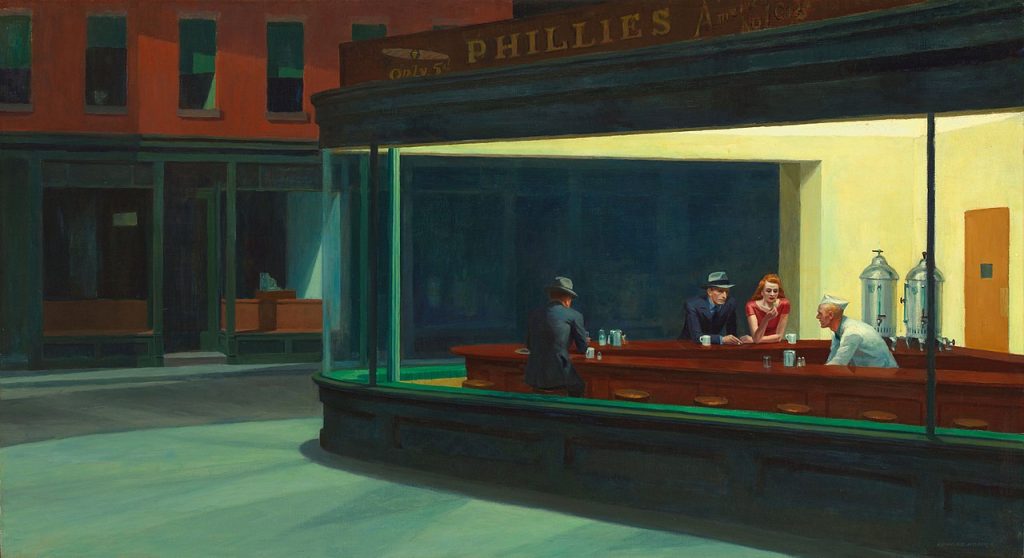
Light is arguably Hopper’s primary subject. It is never incidental. It floods empty rooms, casting long, sharp-edged shadows that function almost as characters in his dramas. In Morning Sun, the light streaming through the window is not a gentle dawn but a harsh, geometric slab of brightness that confronts the figure, separating her from the cool shadows of the room. His palette, too, evolved toward the psychological. Early Impressionist influences gave way to more austere, bleached-out color schemes. The deep greens of a nighttime diner in Nighthawks, juxtaposed with the sickly fluorescent glow of its interior, create an aquarium-like atmosphere, simultaneously beautiful and alienating. These spaces of urban life—an anonymous automat, a late-night diner, a Chop Suey restaurant—become stages where the drama of modern isolation is played out in precise, deliberate stillness.
Nighthawks: The Quintessential Modern Icon
No discussion of Hopper is complete without a special focus on Nighthawks (1942), arguably his most recognizable work and a definitive icon of American art. Painted shortly after the bombing of Pearl Harbor, the image of a brightly-lit urban diner on an otherwise deserted city block captured a specific cultural moment of unease and anxiety. The diner’s glass facade creates no barrier between the interior and the shadowy, threatening street, yet the figures seem sealed in their own separate worlds. A man and a woman sit close but do not touch; we may catch a glimpse of their togetherness, but true connection appears elusive. A lone man sits with his back to us, the nocturnal “hawk” surveying the night. The composition is a cunning arrangement of transparency and opacity, light and shadow, proximity and distance. Its atmosphere—part poetic melancholy, part cinematic suspense—has made it endlessly reproduced and reinterpreted, a testament to its grip on the collective imagination.
An Enduring Legacy
Edward Hopper died in his New York studio in 1967, with only a handful of people attending his funeral—a quiet end that seemed a continuation of his lifelong subjects. However, his artistic legacy boomed posthumously. He left behind a visual grammar that has deeply influenced other creative fields, from the suspense of Alfred Hitchcock’s Psycho to the sprawling cinematic vistas of Wim Wenders. His visibility soared on the art market as well; his 1929 painting Chop Suey sold for an astounding $91.8 million in 2018. This enduring relevance lies in his ability to find the extraordinary within the ordinary. Hopper’s art captures more than just a mid-century American landscape; it reveals a timeless, universal truth echoing through the quiet hum of a fluorescent light, the slant of morning sun on a wall, and the silent weight of our own interior lives.


No responses yet