
Table of Contents
The Aesthetic of Ascent: Whirling Dervishes and the Visual Theology of Ecstasy
In a quiet hall in Konya, Turkey, a hushed silence descends. The ney (reed flute) begins its plaintive cry, a sound described by the poet Rumi as the soul’s longing for return. From a line of black-clad figures, a man in a tall brown hat and a white skirt steps forward. He removes his black cloak, symbolizing the tomb of the ego, and extends his arms: his right hand open to the heavens, receiving divine grace; his left hand turned toward the earth, channeling that grace to the world. He begins to turn.
Slowly at first, then with a gathering, serene momentum, he becomes a pivot of white, a spinning axis around which the very room seems to orbit. This is the Sema ceremony of the Mevlevi Order, the Whirling Dervishes—a practice that is not performance, but prayer. Its aesthetics are not merely decorative; they are a visual theology, a cosmology in motion, where form, movement, and symbol unite to map the soul’s journey to divine unity.
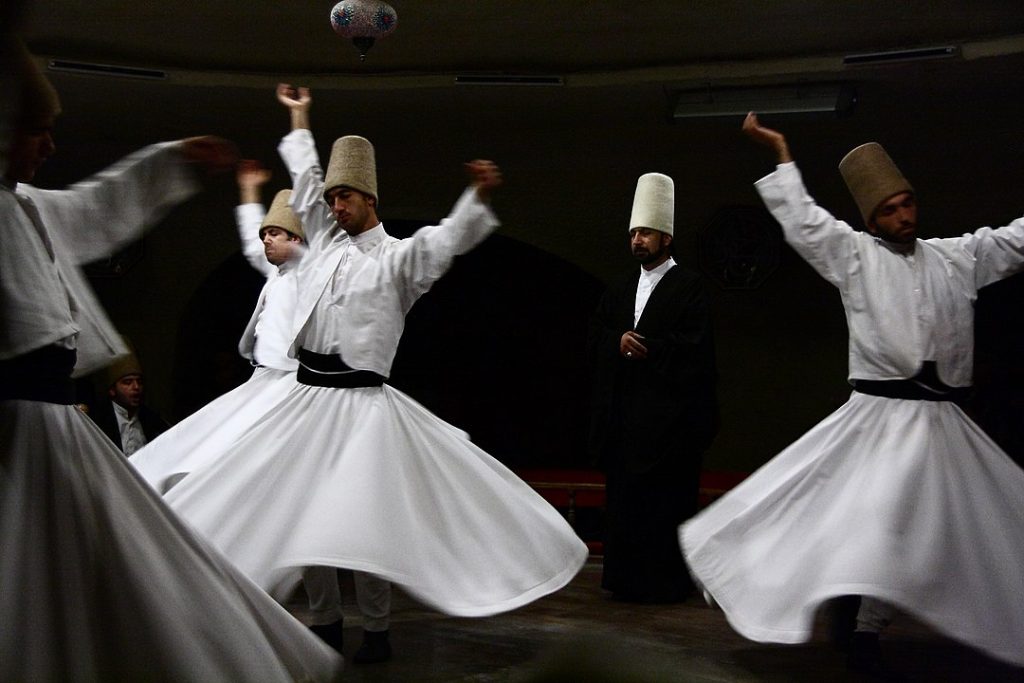
Image: By Schorle – Own work, CC BY-SA 3.0, https://commons.wikimedia.org/w/index.php?curid=12187472
I. The Architecture of Symbolism: Attire as Sacred Text
The aesthetic of whirling is, first and foremost, an architecture of symbolism. Every element of the dervish’s attire and posture is a carefully scripted hieroglyph.
- The Sikke (Hat): The tall brown felt hat represents the tombstone of the self.
- The Tennure (Skirt): The wide, conical white skirt is the self’s shroud. As the dervish whirls, this skirt billows into a perfect circle—a celestial body, the moon, the orbiting planet, the radiant symbol of the perfected soul.
- The Arms and Posture: His arms, held in that graceful, asymmetrical posture, complete the metaphysical circuit: the right hand receives divine grace from above; the left channels it to the earth. This form transforms him into a living letter alif (ا), the first letter of the Arabic alphabet and a symbol of God’s oneness and the upright human being.
- The Black Cloak (Hırka): Discarded at the ceremony’s start, it represents the worldly life and the limited ego left behind at the threshold of mystical ascent.
This is an aesthetic where nothing is arbitrary; every stitch and gesture is a verse in a silent poem about death, transformation, and rebirth.
II. Kinetic Epistemology: Knowing Through the Whirl
The central aesthetic action—the whirl itself—is a kinetic epistemology, a way of knowing through the body and being seen in motion.
The dervish pivots precisely on the left foot, driven gently by the right, in a counter-clockwise rotation around the heart. This is not chaotic spinning, but a meticulously controlled, meditative revolution. It represents the fundamental structure of the cosmos: the orbiting of planets, the rotation of atoms, the circulation of blood, and the revolving cycles of life, death, and rebirth.
As the dervish accelerates, the individual turns blur, the white skirts merge into flowing discs, and the separate dervishes become points in a greater, harmonic pattern. The visual effect is one of dissolving boundaries. The ego, represented by the static, individual form, vanishes into the dynamic, collective dance of existence. The viewer witnesses not a man, but a principle: the soul (nafs) shedding its attachments and turning (dawr) in loving remembrance (dhikr) around its divine center.
III. Visualizing Tawhid: From Multiplicity to Oneness
The core aesthetic experience is the manifestation of tawhid (the doctrine of oneness) through multiplicity and repetition.
The ceremony begins in stillness and separation. The ney’s solo lament speaks of the reed torn from its bed, symbolizing the human soul separated from its divine source. The rhythmic percussion of the kudüm drum enters, like the beating of a heart or the primordial pulse of creation.
Then, the turning begins—one, then many, each dervish on his own axis, yet all moving in synchronized, silent harmony. Visually, this creates a mesmerizing polyphony of forms. The repetitive circling becomes a visual mantra, hypnotic and purifying. The aesthetics here induce a trance-like state not only in the practitioner but often in the witness. The endless revolution becomes a metaphor for the soul’s endless yearning and the infinite nature of the divine. Multiplicity (the many dervishes, the countless turns) is subsumed into a unified, swirling whole—a perfect visual analogue for the Sufi doctrine that all apparent plurality is an illusion veiling a singular, divine reality.
IV. A Spinning Cosmology: The Legacy of Rumi
The aesthetics of the Sema are deeply intertwined with the cosmology of the Persian poet and mystic Jalāl al-Dīn Rumi, the Mevlevi order’s founder.
For Rumi, the universe itself was in a state of loving revolution. “All atoms are whirling,” he writes, “the soul whirled, and the sky / By love of this they’re whirling now.” The whirling dervish thus becomes a microcosm of this macrocosmic truth.
The ceremony’s four selams (salutations) structure the aesthetic and spiritual journey:
- Recognition of divine unity and the human being’s place in creation.
- Witnessing the awe and wonder of all creation.
- The transformative ecstasy of complete surrender and love.
- The soul’s peace, return to its prophetic station, and readiness to serve.
The aesthetics chart this progression: the movements grow more complex, the energy intensifies, and the visual spectacle peaks in a state of sublime, ordered frenzy, before resolving once more into stillness, as the dervishes resume their black cloaks, returning to the world, transformed.
V. Between Sacred Ritual and Secular Spectacle
In a modern, secular context, viewing the Sema poses a fascinating challenge. One can appreciate it purely as performance art: an awe-inspiring spectacle of human discipline, grace, and hypnotic beauty. The stark color contrast of black and white against a simple space, the flowing geometry of the skirts, the haunting music—it is a masterpiece of total theater.
Yet, to stop there is to see only the shell. The true aesthetic power of the whirling dervish lies in its undeniable sincerity as a sacred technology. Its beauty is not applied but emergent, flowing from the inner state of the devotee towards outer expression. This tension itself is part of its modern aesthetic power, inviting viewers to contemplate the line between ritual and art, devotion and discipline.
Conclusion: The Form of the Formless
The aesthetic of the whirling dervish is a profound argument against the duality of spirit and form. It demonstrates that the deepest spiritual truths can—indeed, must—find expression in the material world through disciplined, beautiful form. It is an aesthetics of ascent, a visual liturgy that uses the human body as its medium to diagram the soul’s orbit around the divine.
In the ceaseless, serene whirl of the dervish, we see not a dance for an audience, but a dialogue with the infinite—a silent, spinning sermon on the unity of all things, written not in ink, but in the air itself.

No responses yet