

Table of Contents
The Unbroken Thread: Why Balinese Art Is a Living Prayer
Introduction: Art as Practice, Not Product
On an island where the line between the sacred and the everyday blurs with the morning incense smoke, art is not a product—it is a practice. To understand the art of Bali is to abandon the Western notion of the solitary genius creating for a gallery wall. Here, art is a communal breath, an offering, and a disciplined service to the gods, ancestors, and the intricate, vibrating cosmos. It is a living prayer made visible.
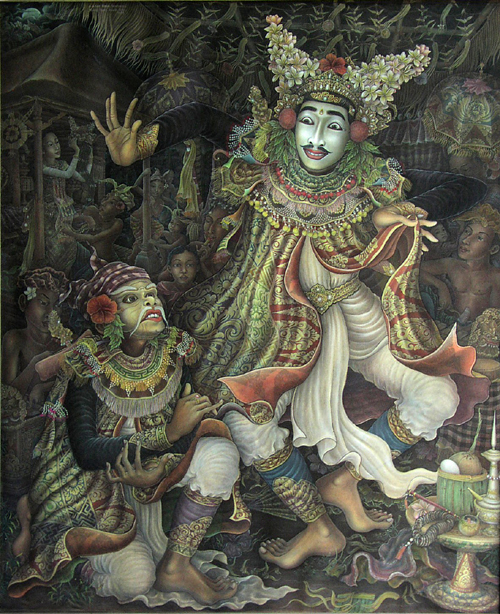
In Bali, the concept of “art for art’s sake” has little historical resonance. Until the early twentieth century, the Balinese language possessed no precise word for “artist” as a distinct professional identity. The painter, the carver, the dancer, and the musician were farmers or merchants first, who fulfilled their communal and spiritual obligations through acts of creation. Their work adorned temples, animated ceremonies, and wrapped the body in sacred cloth, but it was rarely signed. To create beautifully was not a personal statement but a collective responsibility—one woven so deeply into the fabric of daily life that it became as natural as breathing. This fundamental understanding of art as an act of devotion rather than self-expression is the thread that connects every medium, every village tradition, and every generation of Balinese creators.
Cloth as Cosmos: The Sacred Textiles of Bali
This spiritual backbone is most evident in the island’s ancient textile traditions. Consider the sacred geringsing double ikat of Tenganan village—a fabric so complex, requiring years to align the resist-dyed threads to form perfect geometric patterns, that it is believed to possess protective powers. The technique is a form of active meditation, a negotiation between human precision and cosmic order. Unlike single ikat, where only the warp or weft threads are patterned before weaving, the geringsing method demands that both sets of threads are meticulously bound and dyed to match up during the weaving process. The resulting textile shimmers with a subtle, star-like radiance, its patterns—floral rosettes, temple structures, and anthropomorphic figures—said to deflect sickness, misfortune, and malevolent spirits.
Equally significant are the shimmering songket brocades, woven with supplementary gold or silver threads that float above the surface of the cloth like a gilded skin. These textiles, traditionally reserved for the nobility and for the most important lifecycle rituals, transform the wearer into a luminous offering. A bride wrapped in songket is not merely adorned; she becomes a living representation of prosperity, her body a vessel through which divine blessings flow to the community. The rhythmic clacking of the backstrap loom, heard in villages like Sidemen and Gelgel, is itself a kind of sonic prayer, a sound that has accompanied Balinese women through centuries of devotion.
Similarly, the everyday kain (cloth) worn to temple is a profound symbol of wrapping the body—a vessel of animal urges—in a layer of culture and divinity. The waist sash, or saput, is tied tightly to restrain the lower, more bestial instincts, while the kebaya blouse and neatly folded udeng headcloth frame the head and heart as seats of spiritual purity. To be dressed properly is to be a human being, made fit to approach the holy. The very act of dressing is a daily artistic ritual, a reminder that the human form, left bare, is incomplete—it requires the touch of craft, the discipline of tradition, to become a proper vessel for reverence.
The Living Wood: Sculpture as Conduit and Guardian
This negotiation between the human and the divine, between order and chaos, has always defined Balinese visual language. Long before brushes touched canvas, the chisel touched wood, breathing life into the figures that guard temples and homes. The iconography of the Boma head—a forest demon with wide, vegetation-spewing mouth and deep-set eyes—sits above entrance gates not to threaten, but to absorb negative energy, transmuting it before it crosses the threshold. His bulging eyes see what is impure, and his cavernous mouth swallows it whole, protecting the sacred compound within. The carver is not inventing a monster from imagination; he is giving form to a precise, inherited formula, a visual mantra passed down through generations.
This principle extends to the countless statues that populate Balinese temples: the fierce dvarapala guardians kneeling at gateways, one hand raised in a gesture of warning; the serene Prajnaparamita, goddess of transcendent wisdom, seated in perfect equipoise; the riotous depictions of Ramayana heroes frozen mid-battle, their limbs entangled with those of vanquished demons. Each figure is carved according to strict iconographic canons—the proportions of the face, the angle of the limbs, the number of heads or arms—that encode specific cosmic functions. The skill of the carver lies not in sheer imagination, but in his capacity to become a conduit, freeing a form that already hums within the grain of the jackfruit, cempaka, or sandalwood. The final consecration ceremony, known as pasupati, is what transforms a masterfully carved object into a living vessel for divine energy, its eyes ceremonially opened by a priest so it may truly see.
In recent decades, the village of Batubulan has become synonymous with stone carving, its roadside galleries displaying everything from one-tonne temple guardians to miniature, suitcase-sized Buddhas destined for international buyers. Yet even in this commercialized context, the best carvers maintain their devotional discipline. They fast before commencing a sacred commission. They make small offerings to their tools. They understand that the act of removing material—of revealing the form that has waited inside the stone for millennia—is a metaphor for spiritual practice itself: the stripping away of ego, desire, and illusion to reveal the divine nature within.
The Artistic Seismic Shift: Pitamaha and the Modern Balinese Canvas
A seismic shift in this vocabulary occurred in the 1930s, when Western artists like Walter Spies and Rudolf Bonnet settled in Ubud, carrying with them concepts of perspective, anatomy, and individual expression. Spies, a German-Russian musician and painter who had been imprisoned in Russia during the First World War, found in Bali a kind of paradise that resonated deeply with his romantic sensibilities. Bonnet, a Dutch academic painter, brought a rigorous understanding of human proportion and the play of light on skin. They arrived not as colonial masters dictating aesthetic terms, but as fascinated collaborators, profoundly moved by the richness of the Balinese visual tradition they encountered.
Instead of destroying the traditional Kamasan-style narrative painting, with its flattened perspective, stylized puppet-figures, and narrative bands filled with intricate background patterns, this cross-pollination gave birth to a breathtaking modern renaissance. The Pitamaha artist cooperative, founded in 1936 under the patronage of the Ubud royal family, exploded with innovation. For the first time, artists began signing their work. They experimented with light, shadow, and depth. They depicted not just episodes from the great epics but scenes of everyday village life—a woman bathing at a spring, a cockfight in the dust, farmers planting rice in mirrored terraces—rendered with a vibrant, almost intoxicating sensuality.
Artists like I Gusti Nyoman Lempad, already a master architect and sculptor, transferred his stark, sinuous linework to paper with an unparalleled modernist economy. His ink drawings, often depicting episodes from the Mahabharata or Balinese folklore, are miracles of restraint—a single flowing line captures a battle, an embrace, a demon’s snarl, with a cryptic, powerful minimalism that feels startlingly contemporary. Meanwhile, the young prodigy I Gusti Made Deblog painted demons and mythical creatures in swirling, bioluminescent hues, as if the canvas itself were a dark, sacred pond suddenly teeming with light and life. His compositions are dense, electric, almost hallucinatory, each scale and flame rendered with the obsessive detail of a traditional Kamasan painter but charged with a new, personal intensity. They transformed narrative from a static, hieratic courtly form into a dynamic, intensely personal spectacle.
This period also saw the emergence of artists like Anak Agung Gede Sobrat, whose jewel-toned depictions of dancers and market scenes captured the delicate beauty of Balinese femininity, and Ida Bagus Made, who brought a surreal, psychologically charged energy to traditional mythological themes. What united these artists was not a single style but a shared conviction: that Balinese art could absorb outside influences without losing its soul, that the ancient stories could be retold in a modern visual language without diluting their power.
The Dancing Body: Sacred Gesture, Animated Icon
This spirit of dynamic interpretation finds its most profound expression not on a wall, but within the body. Balinese dance is the art of the animated icon. To watch a trained dancer is to see a temple relief come to life—the sharply angled elbows, the impossibly curved fingers, the neck sliding in precise, rhythmic isolations while the eyes perform their own independent choreography. The legong, a dance of divine nymphs performed by young girls before they reach puberty, is a study in controlled asymmetry. Their eyes dart to an intricate gamelan beat that the rest of the body resists, fingers bending back at impossible angles while gilded headdresses tremble with every measured step.
The dancer’s body becomes a vibrating instrument of energy, shifting from the soft, fluid movements of a celestial maiden to the hard, piercing stare of a warrior in the Barong dance. This endless, ritualized battle between Barong, the lion-like spirit of protection, and Rangda, the queen of dark magic, is not a story of good versus evil to be won or lost. It is a living philosophy of balance—Rwa Bhineda—a recognition that destruction and creation are locked in an eternal dance, and the cosmos rests in the tension between them. When Rangda’s long tongue lolls and her white mane of hair flies wild, the men who rush forward with their kris daggers do not attempt to slay her. Instead, in a trance state, they press the blades to their own chests, bending the steel but drawing no blood, a dramatic demonstration that spiritual purity can neutralize even the most potent dark magic. The Barong does not vanquish Rangda; the dance ends with neither victor, only the restoration of equilibrium.
The transmission of this art form is intensely embodied. A master teacher does not explain with words; she stands behind the student, manipulating limbs, tilting the head, pressing the small of the back into alignment. The student learns not through intellectual understanding but through muscle memory, through the body absorbing the form until the form becomes second nature. In this, dance is akin to the carving of wood or the weaving of cloth—it is a physical knowledge passed from body to body across centuries, a living chain of transmission that no textbook could ever replace.
Contemporary Visions: Djirna and the Grammar of Ritual
Today, the tightrope between tradition and modernity, ritual and commerce, is walked by artists like the late, visionary I Made Djirna. His large-scale installations, built from river stones, burnt wood, and shattered terracotta, exude a raw, primal energy. They feel simultaneously like unearthed temple artifacts and stark contemporary commentaries on environmental ruin. A work might feature a single industrial pipe dripping water into an ancient stone vessel, a quiet but devastating portrait of Bali’s sacred springs under threat. His art proves that the Balinese creative spirit is not a relic preserved in amber; it’s a vital, responsive force that uses the grammar of ritual to speak to a fragmented present.
Djirna, who passed away in 2022, spent much of his career exploring themes of water, memory, and loss. He collected discarded objects—fragments of old wooden boats, corroded metal tools, shattered pottery—and reassembled them into altars to impermanence. His work “Air Mata” (Tears) featured hundreds of terracotta vessels suspended from a ceiling, each catching a single drop of water that fell at intervals, a meditation on scarcity, grief, and the preciousness of every tear. For Djirna, the artist was still a conduit, still a priest of sorts, but the message had shifted from celebrating cosmic order to mourning its fragmentation.
He is not alone. Across Bali, a generation of contemporary artists grapples with what it means to be Balinese in an era of mass tourism, environmental crisis, and globalized culture. Sculptor Nyoman Nuarta, creator of the colossal Garuda Wisnu Kencana monument that now towers over the Bukit Peninsula, fuses traditional mythology with the epic scale of modern engineering. Painter I Nyoman Masriadi delivers muscular, darkly comic figures that critique consumerism and machismo with an edge sharpened by global pop culture. Ceramicist and activist I Wayan Gama creates haunting installations from discarded plastics, transforming the debris of tourism into ghostly jellyfish and coral that speak of polluted oceans. These artists argue, through their work, that tradition is not a fixed point in the past but a living language capable of absorbing new vocabulary and confronting new realities. As long as the core intention—the offering, the question, the prayer—remains intact, the art remains unmistakably, irreducibly Balinese.
Conclusion: Beauty as a Moral Obligation
To walk through an artist’s compound in Ubud, to visit a stone-carver’s dusty workshop in Batubulan, or to witness a temple festival where a thousand women wear identical, perfectly folded kebaya, is to understand a central truth. In Bali, beauty is not an aesthetic choice; it is a moral obligation. It is a magnet for the gods. To create beautifully, with undivided attention and intention, is to bring order, however temporarily, to the chaos of existence.
This worldview, known locally as ngayah—selfless service through work—infuses every act of making. The woman who spends an hour weaving a palm-leaf offering basket, only to see it swept away by afternoon rain, is not discouraged. The offering was seen by the divine; its physical dissolution is part of its purpose. The dancer whose career ends with the onset of puberty has not “lost” her art; she has fulfilled it, her body having served its sacred function. The carver who knows his temple statue will be dressed, fed, and worshipped as a living being understands that he has not created an object but a vessel.
And in that act of offering—whether a simple palm-leaf basket on a doorstep or a masterful painting, a monumental sculpture or a contemporary installation confronting ecological grief—a thread remains unbroken, tethering an ancient world to the beating heart of the now. Balinese art endures not despite the pressures of modernity but precisely because it possesses the spiritual and philosophical resources to meet those pressures head-on. It asks not what is new, but what is true. And in a world that often forgets the difference, that question itself is a form of prayer.


No responses yet