

Table of Contents
Norman Rockwell: The People’s Painter and the Divided Legacy of an American Icon
In 1949, an art student approached a gawky, middle-aged man browsing the Renaissance galleries of the Art Institute of Chicago. “Are you Norman Rockwell?” she asked. When he nodded, she delivered her verdict: “My teacher says you stink,” and walked away. The anecdote, which Rockwell would retell throughout his life with a mixture of hurt and wry amusement, captures the fundamental tension that defined his career. Here was America’s most famous artist, a man whose name was synonymous with an entire visual language of national identity, being told in no uncertain terms that his work did not matter. The art establishment of the mid-20th century, enraptured by Abstract Expressionism and the cult of the avant-garde, had little patience for an illustrator who painted soda jerks, Thanksgiving dinners, and small-town gossip with fastidious realism.
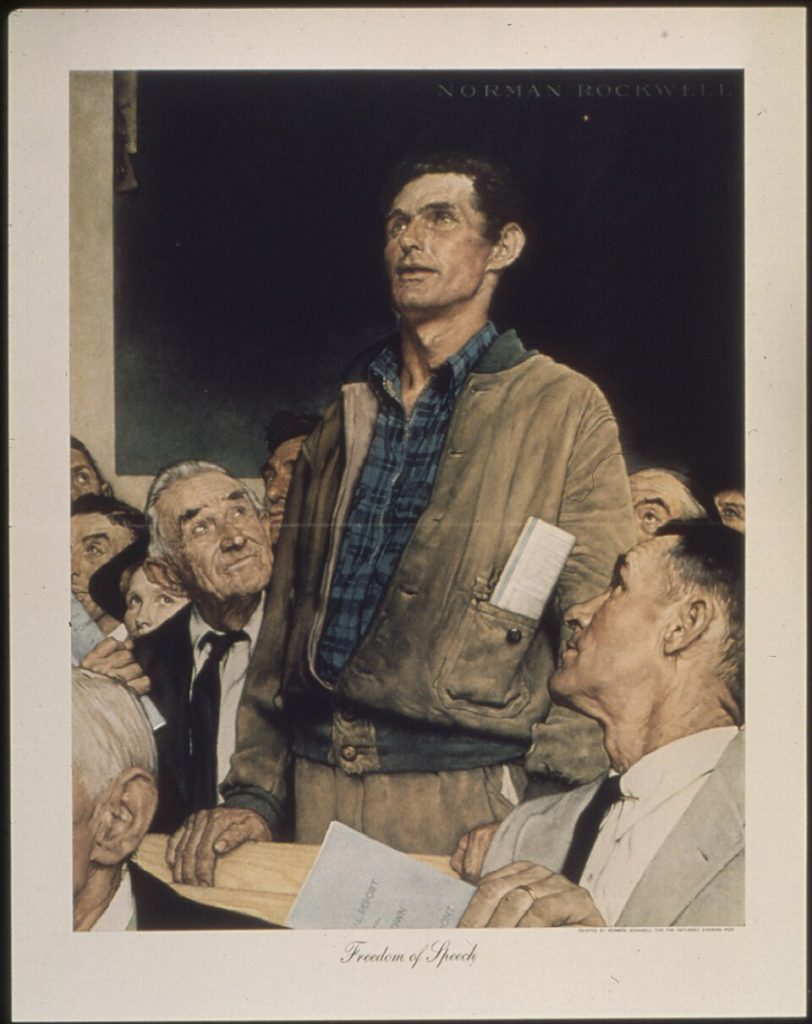
But the story of Norman Rockwell is more complicated — and more interesting — than either his admirers or detractors have often acknowledged. It is the story of an artist who spent decades perfecting a vision of America that was both cherished and derided, only to risk that reputation in his final years by confronting the nation’s deepest wounds. To understand Rockwell is to grapple with questions that remain urgent today: What is art’s relationship to popularity? Can sentimentality coexist with truth? And who gets to decide what counts as “serious” painting?
The Making of a Storyteller
Norman Percevel Rockwell was born in New York City in 1894, and from the beginning, he possessed a sense of purpose unusual for a child. He knew he wanted to draw. By 14 he had transferred from high school to art school, eventually landing at the Art Students League, where he received rigorous training in draftsmanship and composition. His teachers — Thomas Fogarty, George Bridgman, Frank Vincent DuMond — instilled in him the disciplines of academic realism, skills that would become both the foundation of his success and the grounds for later criticism.
Rockwell’s rise was meteoric. At 18, he landed his first major commission illustrating a children’s book. At 19, he became art director of Boys’ Life magazine, the publication of the Boy Scouts of America. And at 22, he painted his first cover for The Saturday Evening Post — the beginning of a 47-year relationship that would produce 323 covers and make his face, or rather his work, a weekly presence in millions of American homes. This was mass media before television had fully conquered the living room, and Rockwell’s covers functioned as a kind of national visual diary, a mirror in which Americans could see themselves — or at least a version of themselves they wanted to believe in.
What made Rockwell’s images so compelling was his mastery of narrative art. Each cover was a short story in a single frame, a moment frozen in time that implied a past and promised a future. His technique was exacting. He would stage scenes like a film director, posing friends, family, and neighbors in carefully orchestrated tableaux. Photographers captured these setups as reference images, and Rockwell would labor over the resulting paintings with obsessive attention to detail — every rumpled shirtsleeve, every wisp of hair, every gleam on a shoe captured with precision. This was not realism from life, exactly, but realism constructed, engineered to produce a specific emotional response.
The Case Against Rockwell
To understand why Rockwell became so controversial, one must understand what the art world valued during his prime. The mid-20th century belonged to Abstract Expressionism, Minimalism, and conceptually driven art. Critics and curators prized originality, difficulty, and a certain intellectual austerity. Against this backdrop, Rockwell’s work seemed almost willfully naïve — a catalogue of small-town nostalgia rendered with a technical skill that, his detractors argued, was put entirely in service of sentimental cliché.
Vladimir Nabokov, never one to pull punches, wrote that Rockwell’s “brilliant technique” was put to “banal” use, and he memorably quipped in Pnin that Salvador Dalí was really Norman Rockwell’s twin brother “kidnapped by gypsies in babyhood”. The deprecatory adjective “Rockwellesque” entered the language as shorthand for an America that was overly sweet, simplistically wholesome, and perhaps never truly existed. Critics saw bourgeois wish-fulfillment — images designed not to challenge their audience but to comfort them, to reassure middle-class America that its values were timeless and its way of life divinely sanctioned.
This critique carried weight. Many of Rockwell’s Post covers did present an idealized vision that papered over the complexities and cruelties of American life. For decades, the magazine maintained an editorial policy restricting depictions of Black people to service roles, and Rockwell, however quietly he may have chafed against this, largely complied. His America was overwhelmingly white, comfortably middle-class, and untouched by the Great Depression’s lingering traumas or the gathering storm of the civil rights movement. The very quality that made his work so beloved — its evocation of a simpler, kinder nation — was also, from another angle, a form of erasure.
The Turn: Civil Rights and The Problem We All Live With
Then, in the 1960s, something shifted. Rockwell had spent over four decades at The Saturday Evening Post, but the constraints of its editorial vision increasingly frustrated him. The civil rights movement was roiling the country, and Rockwell, now in his late sixties, found himself unable to continue painting the sunny fictions of the past. In 1963, he left the Post for Look magazine, a publication far more engaged with the social upheavals of the era. What followed was the most radical reinvention in the career of any major American illustrator.
The result was The Problem We All Live With (1964), a painting that remains, more than half a century later, one of the most potent visual statements of the civil rights era. The composition is startlingly direct. A young Black girl — six-year-old Ruby Bridges, though Rockwell used a local model named Lynda Gunn — walks in profile, her white dress a beacon of innocence against a wall defaced with racist graffiti and the splattered remains of a thrown tomato. She is flanked by U.S. Marshals, but their faces are cropped out, so the viewer sees only their imposing suits and determined gaits. The perspective places us directly behind the unseen mob whose hatred stains the wall. The painting is a masterpiece of narrative economy: every detail, from the scrawled racial slur to the girl’s immaculate white sneakers, works to heighten the moral drama of a child simply walking to school.
The reaction was seismic. Rockwell received “sacks of disapproving mail,” including letters accusing him of being a race traitor. But other letters poured in from readers moved to tears by the image. A Tennessee man wrote, “I have never been so deeply moved by any picture,” while a Florida reader said she was saving the issue for her children in the hope that its subject matter would “have become history” by the time they were old enough to understand it. Rockwell had done something almost unthinkable for an artist of his generation and stature: he had used his vast commercial platform, the same platform that had traded in nostalgia for decades, to force his audience to confront the ugliness of the present.
Murder in Mississippi and the Limits of Perfection
Rockwell followed The Problem We All Live With with an even darker work. In 1965, Look sent him to illustrate the murder of three civil rights workers — Michael Schwerner, Andrew Goodman, and James Chaney — who had been killed by the Ku Klux Klan in Philadelphia, Mississippi, the previous summer. Rockwell threw himself into the project with obsessive intensity. He combed through news reports, studied weather conditions from the night of the killings, and staged models in his studio with the exacting precision he had honed over a lifetime. At one point, realizing he needed to paint blood on a shirt, he smeared himself with real blood — whose, we don’t know — and photographed his own shoulder for reference.
And yet, the final painting disappointed him. “All the rage had drained out of it,” Rockwell admitted later. The polished oil painting felt too perfect, too controlled to capture the raw horror of the subject. In a letter to Look art director Allen Hurlburt, he confessed: “If I just had a bit of Ben Shahn in me, it would have helped”. Shahn, a fellow artist known for his gritty social realism, represented everything Rockwell’s meticulous style was not — rough, immediate, unflinching. The magazine ultimately ran not the finished painting but Rockwell’s preliminary sketch, a dark, quavering study that Hurlburt recognized as more powerful precisely because of its unfinished quality. It was, as one critic later wrote, “the least Rockwell Rockwell you’ll ever see” — and perhaps, for that very reason, “also the most”.
Reassessing the Legacy
Time has a way of reshuffling reputations, and Rockwell’s has fared better than his mid-century critics might have predicted. The Norman Rockwell Museum in Stockbridge, Massachusetts, now houses the world’s largest collection of his original works and welcomes visitors from around the globe. His paintings sell for millions at auction — Saying Grace fetched over $46 million in 2013. But the financial metrics only tell part of the story.
More significant is the ongoing reexamination of Rockwell’s cultural significance. Recent exhibitions have reimagined his iconic scenes through diverse, contemporary lenses, and his family has publicly spoken out when his imagery was used for political purposes they believed he would have opposed. The artist who was once dismissed as a purveyor of kitsch is now increasingly studied as a complex figure whose career mirrors the larger tensions of 20th-century America — between idealism and reality, between comforting fictions and hard truths.
There is a case to be made that Rockwell’s late-career turn was not a repudiation of his earlier work but a fulfillment of it. The same narrative instincts that made Freedom from Want so resonant — the ability to locate universal emotion in a specific moment — are what give The Problem We All Live With its enduring moral force. Rockwell always understood that a single image could tell a story more powerfully than a thousand words. What changed was the kind of stories he chose to tell.
Charles Harris, a lecturer for the UK Arts Society, once offered a defense that cuts to the heart of Rockwell’s appeal. “I can think of no other artist who tried so hard to never offend, and to always delight middle class Americans,” Harris said. But he added: “Anybody who wants to know how to tell or portray a story needs to understand how Rockwell did it in a single image — 4,000 times”. The first statement captures what remains problematic about the earlier work; the second captures what makes Rockwell, at his best, still worth studying.
Perhaps the most fitting assessment came from Ruby Bridges herself, the woman who as a child inspired Rockwell’s most famous painting. She never met the artist, but as an adult she reflected on his courage: “Here was a man that had been doing lots of work, painting family images, and all of a sudden decided this is what I’m going to do… it’s wrong, and I’m going to say that it’s wrong”. In 2011, at Bridges’ suggestion, President Barack Obama had The Problem We All Live With installed in a hallway outside the Oval Office. She and Obama stood before it together, and the president said, “I think it’s fair to say that if it hadn’t been for you guys, I might not be here and we wouldn’t be looking at this together”.
Norman Rockwell was not a revolutionary, and much of his work remains mired in a sentimental vision of America that never fully existed. But in his final act, he did something that many greater artists never attempt: he looked at his own legacy, recognized its limitations, and chose to use his remaining years and his hard-won fame to say something true. That, in the end, is what gives his work its staying power. He was an artist of the people — and when the people needed to see not just what they aspired to be but what they actually were, he was willing to hold up that mirror too.


No responses yet