

Table of Contents
The Bust of Nefertiti and Its Artistic Value
The bust of Nefertiti is one of the most revered and controversial artworks in the world. Crafted over 3,300 years ago, this painted limestone sculpture has transcended its function as a mere archaeological artifact to become a global icon of beauty, a subject of political debate, and a powerful muse for contemporary artists. Its story is a rich tapestry woven from threads of ancient artistry, 20th-century colonial ambition, and modern cultural identity, making it a work of immense and complex artistic value.
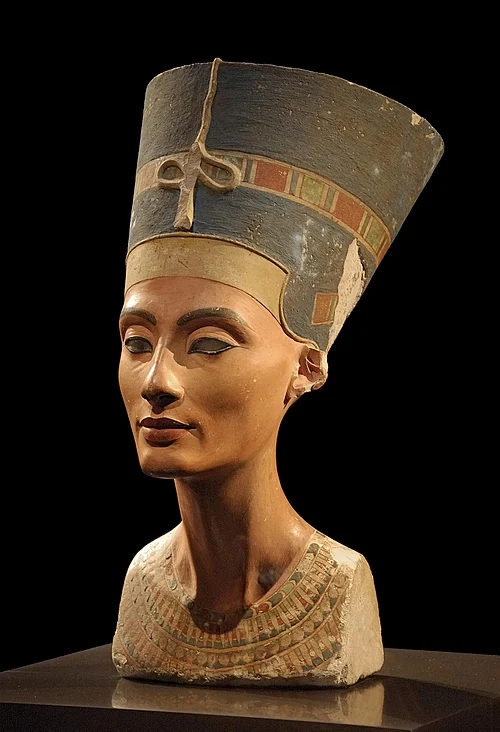
Image: By Philip Pikart – Own work, CC BY-SA 3.0, https://commons.wikimedia.org/w/index.php?curid=8433730
This essay explores the bust’s artistic value through three primary lenses: its masterful creation and aesthetic ideals, its contentious journey to Berlin and the debates over ownership it has sparked, and its enduring legacy as a symbol that continues to inspire and provoke in the modern world.
A Masterpiece of Ancient Craftsmanship
The artistic genius of the Nefertiti bust lies in the skillful hand of its creator, the sculptor Thutmose, who crafted the work around 1345 B.C.E. in his workshop at Amarna. The bust is made of a limestone core, which was then meticulously layered with painted stucco.
This technique allowed Thutmose to achieve a remarkable level of detail and a lifelike quality that has captivated viewers for a century. The colors themselves—the blue of her iconic “Nefertiti cap crown,” the warm tone of her skin, and the rich blacks of her kohl-rimmed eyes—are made from ground minerals like copper oxide and iron oxide, demonstrating a sophisticated understanding of materials.
The bust is renowned for its nearly perfect symmetry and its idealized yet realistic portrayal of the queen. The piece is often described as the epitome of feminine beauty, featuring a slender, “swan-like” neck, high cheekbones, a chiseled jawline, and an expression of serene confidence. However, modern technology has revealed a fascinating secret beneath the surface. A CT scan uncovered a more realistic, wrinkled face carved into the inner limestone core, showing creases around the mouth and a bump on the nose.
Thutmose had added an outer layer of stucco to smooth out these features, bringing the bust closer to the aesthetic ideals of the time. Some scholars suggest the bust was a master’s modello—a teaching tool or official model—which would explain why the left eye lacks the quartz inlay of the right, potentially left unfinished for instructional purposes. This duality of a realistic core hidden beneath an idealized surface adds a profound layer of depth to the work, hinting at the artistic process and the power of representation in ancient Egypt.
A Symbol of Controversy and Colonial Legacy
The story of the bust’s discovery and its journey to Berlin is as dramatic as its creation. In 1912, a German archaeological team led by Ludwig Borchardt unearthed the bust in the remains of Thutmose’s workshop. Borchardt’s diary entry captures the moment: “Suddenly we had in our hands the most alive Egyptian artwork. You cannot describe it with words. You must see it.” The following year, the bust was shipped to Germany. However, the circumstances of its removal have been a source of intense debate for decades.
Egypt accuses Borchardt of smuggling the artifact by wrapping it to conceal its value and misleading an Egyptian antiquities inspector about its significance. The Germans maintain the division of finds was conducted fairly according to the customs of the time.
Since its public unveiling in Berlin in 1924, the bust has been at the center of a fervent repatriation dispute, with Egypt repeatedly demanding its return. For many Egyptians and people of African descent, the bust is not just a beautiful object but a vital piece of heritage, a symbol of Africa’s history and cultural dominion that was taken during an era of European colonialism.
The fact that it remains in the Neues Museum in Berlin, despite these calls, makes the bust a powerful symbol in the ongoing global conversation about cultural patrimony and the role of Western museums in holding onto artifacts from their former colonial spheres of influence. This context is inseparable from its artistic value today; to view the bust is also to confront the complex history that brought it to its current home.
An Enduring Muse in Contemporary Culture
Beyond the museum walls, the bust of Nefertiti has taken on a life of its own, evolving into a blank canvas onto which successive generations project their own ideas about gender, race, and power. As one scholar noted, “Nefertiti tells us more about ourselves than she does about her.” This is most evident in the work of contemporary artists. For instance, one artist connects Nefertiti with Black cultural power, illuminating her profile with neon lights in a modern art piece. Another project presents five busts in a spectrum of skin tones, directly challenging viewers to confront their own assumptions about the queen’s race and identity.
The queen’s influence is also deeply embedded in popular culture and fashion. In the beauty industry, her look is endlessly replicated, from makeup tutorials to a cosmetic procedure named for its ability to create a defined jawline. She has been a muse for major fashion houses. Crucially, for many Black women and artists of the African diaspora, Nefertiti is a symbol of ancestral beauty and power.
Iconic musicians have famously drawn from her image, reclaiming and celebrating a figure whose European reception has often involved a degree of “whitewashing.” Some artists have even linked her to African American material culture, embedding impressions of the Nefertiti bust alongside cultural staples of Black urban fashion, thereby asserting a continuous line of cultural and aesthetic heritage.
Conclusion
The artistic value of the Nefertiti bust is multifaceted and ever-evolving. It is, at its core, a breathtaking masterpiece of ancient Egyptian art, a testament to the skill of Thutmose and the power of the queen he portrayed. Yet, its value cannot be contained by its physical form or its moment of creation. The bust’s contentious history as a symbol of colonial appropriation has imbued it with a political weight that forces a critical engagement with the ethics of museum collections.
Finally, its remarkable afterlife as a muse for contemporary artists and a global pop-culture icon demonstrates its profound and continuing relevance. It has become a vessel for discussions on race, gender, and identity, proving that some artifacts are not just remnants of the past but active participants in shaping the cultural conversations of the present. The bust of Nefertiti, the “beautiful one,” is thus a work whose beauty is inextricably linked to the complex, compelling, and sometimes contentious narratives that surround it.


No responses yet