
Table of Contents
The Aesthetics of the Stoicism: Beauty, Order, and the Rational Cosmos
Introduction: Beyond Ethics—Stoicism as a Way of Seeing
When we speak of Stoicism, the mind typically turns to its ethical teachings: the endurance of hardship, the mastery of passion, the pursuit of virtue. Yet, to confine Stoicism to the realm of ethics alone is to overlook a profound and integral dimension of the philosophy—its aesthetics. The Stoic worldview, developed by thinkers like Zeno of Citium, Chrysippus, Seneca, Epictetus, and Marcus Aurelius, presented a unified vision of the cosmos that was deeply aesthetic. For the Stoics, beauty was not a mere sensory pleasure but an objective feature of a rational, ordered, and divine universe.
Their aesthetics was inseparable from their physics, logic, and ethics, forming a cohesive understanding of a beautiful life lived in accordance with nature. This essay will explore the foundational principles of Stoic aesthetics, examining its roots in cosmic order, its manifestation in art and rhetoric, its ethical imperative for the “inner statue,” and its enduring legacy.
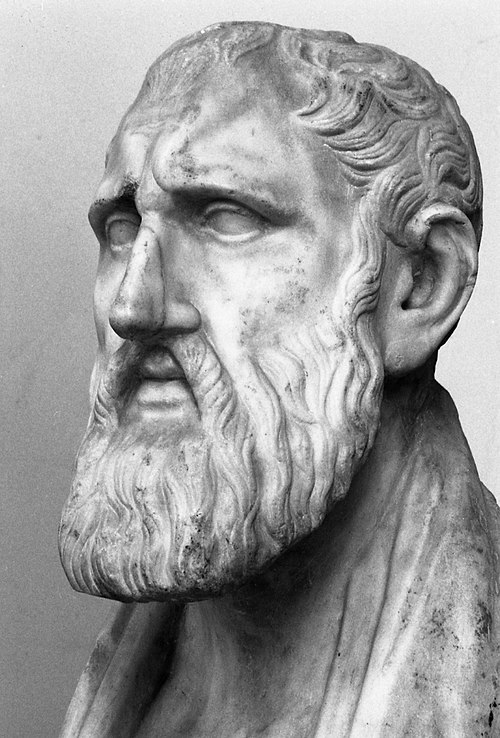
Image: By Paolo Monti – Available in the BEIC digital library and uploaded in partnership with BEIC Foundation.The image comes from the Fondo Paolo Monti, owned by BEIC and located in the Civico Archivio Fotografico of Milan., CC BY-SA 4.0, https://commons.wikimedia.org/w/index.php?curid=48067347
The Foundation: Cosmic Sympathy and the Logos
At the heart of Stoic aesthetics lies their unique cosmology. The Stoics conceived of the universe as a single, living, rational, and divine entity—a cosmopolis (world-city) governed by an active principle called the Logos (Divine Reason, Providence, or God). This Logos permeates all matter, shaping it with purpose and order. The universe undergoes eternal cycles of conflagration and rebirth, each iteration perfectly ordered by reason.
From this cosmology emerge two key aesthetic principles:
- Unity-in-Diversity (Sympnoia): The Stoics believed in “cosmic sympathy” (sympnoia), the idea that all parts of the universe are interconnected and interdependent, like the limbs of a single body. This creates a beauty of harmonious relationship. The vast diversity of phenomena—stars, oceans, animals, humans—is not chaotic but a complex, unified whole. The beauty lies in the intricate fittingness of each part to the whole, a grand, dynamic composition authored by the Logos.
- Purposeful Order (Taxsis): Beauty is fundamentally tied to functionality and order. A thing is beautiful when it perfectly serves its purpose within the cosmic system. The Stoic sage observes the natural world—the cycle of seasons, the mechanics of celestial bodies, the functional anatomy of a living creature—and sees not random happenstance but the elegant artistry of divine reason. As Marcus Aurelius reflects in his Meditations (IV, 23), “Everything is interwoven, and the web is holy.” The very structure of reality is aesthetic.
This cosmic perspective reframes beauty from a subjective preference to an objective fact about a well-ordered whole. To perceive the world truly is to perceive its beauty.
Art and Rhetoric: The Mirror of Nature
Given their veneration of natural order, the Stoics developed a corresponding aesthetic for human artifice. Their theory of art and rhetoric was not one of free, expressive creation but of mimesis (imitation) guided by reason.
- Art as Selective Imitation: Stoics like Seneca and Epictetus held that art should imitate nature, but not in a slavish, photographic sense. True artistic mimesis selects and represents the ideal and characteristic features of nature, focusing on its underlying rational principles. A sculpture should capture the essential form and purpose of the human body, not its incidental flaws. A painting should reflect the harmonious order found in nature’s landscapes.
- The Primacy of Content and Function: Stoic rhetoric, heavily emphasized in their pedagogy, showcases their aesthetic priorities. For Cicero (who incorporated Stoic ideas), and later Seneca, beautiful speech (venustas) was inseparable from truth and moral utility. Rhetorical beauty arises from:
- Clarity (perspicuitas): The transparent communication of truth.
- Appropriateness (decorum): Style fitting to subject and purpose.
- Logical Structure: Arguments woven together with the same rational order found in the cosmos.
- Moral Purpose (utilitas): Speech aimed at improving the listener.
Ornament for its own sake was suspect; fancy diction and empty poetic flourishes were seen as a kind of vice, a distraction from truth. The most beautiful speech was the one that most effectively guided the soul toward wisdom, just as the cosmos guides all things toward their proper end. The aesthetic value of human production was thus measured by its fidelity to, and its role within, the rational order of nature.
The Human Aesthetic: Sculpting the Inner Statue
The most profound application of Stoic aesthetics is to the human soul itself. If the cosmos is a beautiful work of art by the Logos, then the supreme task of a rational human being is to become a microcosm of that beauty. This is the core of Stoic ethics, framed in aesthetic terms.
- The Sage as the Aesthetic Ideal: The Stoic sage—the rarely attained perfect individual—is the living embodiment of beauty. This beauty is entirely moral and rational. It consists in:
- Harmony (harmonia): A soul where judgment, desire, and impulse are in perfect alignment with reason, free from the discord of irrational passions (pathē).
- Proportion (symmetria): The classic Greek aesthetic ideal applied inwardly. Each part of one’s life—judgments, actions, reactions—is given its proper, measured weight.
- Fitness (aptum): Actions that are “fitting” or “appropriate” (kathēkonta) to one’s role as a rational citizen of the cosmos.
- The Work of Self-Cultivation: Epictetus famously used the metaphor of the sculptor. “You are a little soul carrying around a corpse,” he says, urging discipline of the body (Discourses, 4.1). More positively, he advises us to “work out your own salvation” like a sculptor with a statue, chipping away at all that is superfluous and disorderly (Enchiridion, 50). The raw material (our impressions, desires, and faculties) is given by nature; our reason is the tool that shapes it into a beautiful character.
- The Beauty of Action: For a Stoic, a beautiful life is a life of virtue in action. The graceful endurance of misfortune (apatheia), the calm performance of duty, the just and courageous act—these are not just good, they are beautiful. They have the elegance of a mathematical solution or a well-executed dance, where every movement is necessary and fitting. Marcus Aurelius constantly reminds himself to act “with a graceful dignity, and a sense of style” (Meditations, III, 1).
The Sublime and the Stoic Gaze: Transforming the Perception of Adversity
A unique and powerful aspect of Stoic aesthetics is its capacity to transform the perception of suffering and the mundane into an experience of the sublime. The sublime—that which inspires awe and terror due to its vastness or power—was a concept later developed by Longinus, but it is prefigured in the Stoic attitude.
The Stoic practice of objective representation (phantasia kataleptike) is key. When faced with a terrifying event—illness, loss, death—the Stoic trains himself to see it not as a “catastrophe” but as a natural event within the cosmic order. He steps back to view it sub specie aeternitatis (under the aspect of eternity). From this cosmic vantage point, what seemed ugly or frightening is revealed as a necessary part of the beautiful, dynamic whole.
Seneca writes of contemplating the spectacle of the universe from above, seeing the “sublime sights” of lands and seas (Natural Questions, I, Pref. 7-9). Epictetus tells his students that when a difficult person provokes them, they should say, “You are just another part of the universal drama” (Discourses, 1.12.26). This re-framing is an aesthetic act: it exchanges a disordered, painful impression for a view of the world as an ordered, if often austere, masterpiece. The Stoic finds a solemn, majestic beauty in the very laws of fate that constrain him.
Legacy and Conclusion: An Enduring Aesthetic of Order
The aesthetics of Stoicism has cast a long shadow. Its emphasis on cosmic unity and rational order influenced Neoplatonism and early Christian thought, which saw the beauty of the world as evidence of a divine creator. Its focus on inner moral beauty as the true form of loveliness became a central theme in Renaissance humanism and later in Enlightenment thought.
In the modern world, Stoic aesthetics offers a powerful counter-narrative to dominant aesthetic paradigms. Against the Romantic cult of individual genius and turbulent emotion, Stoicism offers an ideal of serene, rational harmony. Against the postmodern celebration of fragmentation and subjectivity, it posits an objective, universal beauty rooted in a coherent cosmos.
Ultimately, the Stoic aesthetic is not about creating art to hang on a wall, but about living artfully. It teaches that the most important work of art is one’s own life and character, sculpted through reason to reflect the majestic order of the universe. It invites us to cultivate a gaze that can discern the sober beauty in necessity, the elegance in virtue, and the sublime artistry woven into the very fabric of existence—even, and especially, in its most challenging moments. To see the world as a Stoic is to see it as a beautiful, rational whole, and to find one’s dignified and fitting place within its grand, eternal design.

No responses yet