

Table of Contents
The Visual Art of One Battle After Another: Chaos as Craft
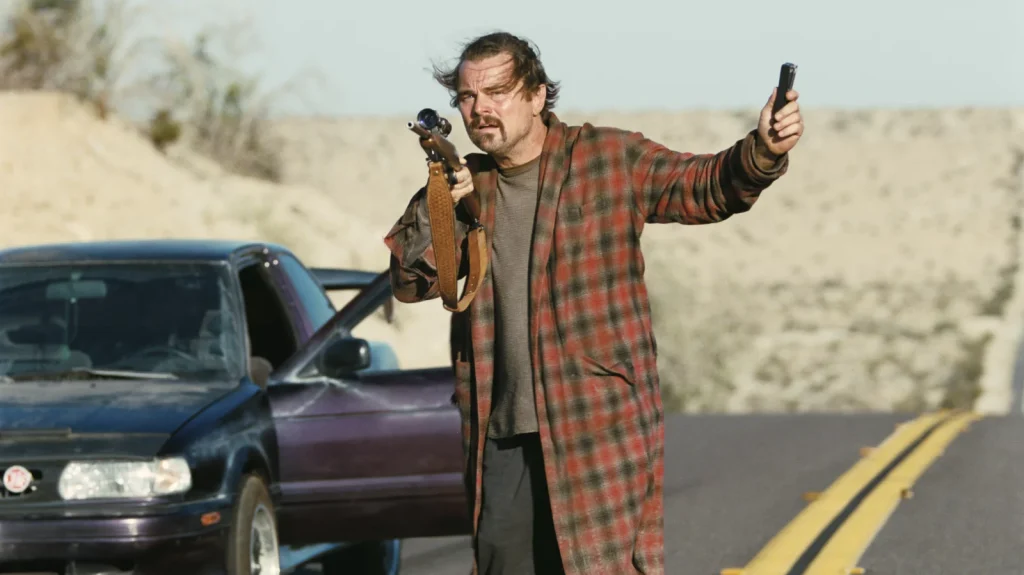
In an age of digital precision and CGI spectacle, Paul Thomas Anderson’s One Battle After Another arrives as a defiant throwback—a film that finds beauty in imperfection, power in rawness, and emotional truth in technical limitation. The movie’s visual language, crafted by cinematographer Michael Bauman, is not merely a stylistic choice but a philosophical statement about what cinema can be. By resurrecting VistaVision, a dormant film format from the 1950s, and marrying it to the gritty, documentary-style energy of 1970s New Hollywood, Anderson has created a work that feels simultaneously ancient and alive, classical and chaotic.
The VistaVision Resurrection
At the heart of the film’s visual identity is its chosen format. VistaVision, developed by Paramount in 1954, was a response to the rise of television—a way to lure audiences back to theaters with images that television could not replicate. Unlike standard 35mm film, which runs vertically through the camera with four perforations per frame, VistaVision runs the film horizontally, using eight perforations per frame. This doubles the size of the negative, creating images of extraordinary richness and depth. The format produced classics like Hitchcock’s Vertigo and North by Northwest before falling out of fashion by the early 1960s.
For decades, VistaVision cameras collected dust. They were used primarily for visual effects photography—George Lucas employed them for the original Star Wars—but not as primary production cameras. Anderson had been fascinated by the format since shooting the short film ANIMA with Thom Yorke, and he was determined to use it for One Battle After Another. This was an audacious choice. As Bauman recalls, his first question was: “Is this even going to be reliable?”
The answer was not straightforward. The Beaumont VistaVision cameras they used—one of them owned by actor and cinematographer Giovanni Ribisi—were temperamental, noisy, and prone to jamming. Each magazine held only about four to five minutes of film, requiring constant reloading. The cameras were never designed for the kind of movement Anderson demanded: handheld work, Steadicam shots, and cameras strapped directly to speeding cars. The production ultimately shot approximately 1.5 million feet of film—more VistaVision footage than had been exposed in decades.
Yet this difficulty became the source of the film’s visual power. As Bauman puts it, the camera “has its own personality.” Working with VistaVision meant embracing its limitations: the brief takes, the noise that required custom-built blimps to muffle, the weight that restricted placement. Rather than fighting these constraints, Anderson and Bauman allowed them to shape the film’s aesthetic. The result is a visual texture that feels earned, organic, and unmistakably cinematic.
The 1970s Influence: Roughness as Virtue
Anderson’s visual reference for One Battle After Another was not the epic VistaVision spectacles of the 1950s but the grittier, more immediate cinema of the 1970s. He pointed specifically to The French Connection and The Last Detail—films with “a certain stylistic roughness” that he felt was “essential in telling this story.” This roughness manifests throughout the film: in the handheld camerawork that feels almost documentary in its urgency, in the willingness to let faces fall into shadow, in the embrace of what might conventionally be called mistakes.
One of the film’s most striking visual principles is its willingness to let darkness remain dark. In an era when many digital productions light night scenes to near-daylight visibility, One Battle After Another returns to a more realistic—and more evocative—approach. Shadows are allowed to consume faces. Backgrounds fall into black. The image is not afraid of contrast. This choice creates a sense of immersion and authenticity; the world of the film feels tactile, lived-in, and genuinely dangerous.
The lighting approach reflected this philosophy. Anderson wanted to maintain a “small footprint” on set, integrating practical lights into the production design rather than flooding locations with massive rigs. He even purchased a set of incandescent lights from 1983 on eBay—a Lowel kit with umbrellas—because he loved their quality. The goal was to allow actors to move freely and to capture spontaneous performances, even if that meant technical imperfections. “Just being comfortable with the uncomfortable,” Bauman calls it.
This philosophy extended to the color and exposure decisions. Rather than relying on digital color correction to fix problems later, Anderson insisted on getting things right in the camera. “Paul doesn’t operate from that space” of post-production fixes, Bauman explains. “You put as much energy on the day as you can toward getting it as right as possible.” In one instance, Bauman suggested using a digital power window to adjust an overly bright shot, and Anderson’s response was a skeptical: “Really? Come on.” The shot stayed as it was.
The Car Chase: VistaVision in Motion
The film’s most celebrated sequence—the car chase through the rolling hills of Borrego Springs, near San Diego—represents the culmination of this visual philosophy. The location itself was discovered by production designer Florencia Martin during a scouting trip. “We instantly felt how special and magnetic and unique it was,” she recalls, “to suddenly be dipping up and down through these hills.” This topography, known as the Texas Dip, became the chase’s defining feature: cars would disappear over crests and reappear moments later, creating a cat-and-mouse tension that traditional flat road chases cannot replicate.
To capture this, Bauman deployed an arsenal of techniques drawn from both classical and experimental traditions. He positioned cameras at the side of the road using extremely long lenses—ranging from 1,000mm to 1,200mm—which compressed the distance between the cars, making them appear stacked closely together as they rose over the hills. Simultaneously, he mounted wide lenses just inches above the road surface, creating a visceral sense of speed as the pavement rushed past. The combination of these approaches—telephoto compression for spatial tension, wide-angle proximity for kinetic energy—produces a chase that is both elegantly composed and viscerally immediate.
Perhaps most remarkably, Bauman strapped the vintage VistaVision cameras directly onto the moving vehicles. The Beaumont camera was never designed for this; it was intended to sit on a tripod and capture stately, composed images. But the production pushed the format to its absolute limits, with cameras vibrating at 70 miles per hour, the film stock running through mechanisms not tested for such conditions in half a century. “We had to discover methods of working within the parameters that the camera would give us on any kind of day,” Bauman says. The resulting footage has a jittery, high-stakes quality that no amount of digital stabilization could replicate—or improve.
The Chapel Scene: Old Hollywood Grandeur
Despite his commitment to roughness and economy, Anderson is not immune to the allure of classical Hollywood composition. The film’s most explicitly “cinematic” shot comes during the confrontation between Willa and Colonel Lockjaw in the chapel of the Sisters of the Brave Beaver mission. Here, Anderson indulges in what he calls “one of those big old-fashioned grand movie shots”: the camera positioned in a high corner, tilted at a slight angle, looking down the length of a long, beautiful room as the hero and villain face off at opposite ends.
Anderson’s philosophy throughout most of the film was to avoid such “gourmet” embellishments. “Don’t get too fussy,” he told himself. “Make the shots that tell the story, because there’s so much story to tell. There’s no room for decorations on top or powdered sugar on it, it has to be very economical.” But when the location and the dramatic moment aligned—when the mission chapel presented itself as a ready-made stage for a face-off—Anderson allowed himself to step outside his own rules. The result is a shot that feels earned precisely because it is an exception. The restraint shown elsewhere makes this moment of visual grandiosity genuinely breathtaking.
Projecting the Vision: VistaVision in Theaters
The commitment to analog purity extended beyond production to exhibition. For the first time in over sixty years, a wide-release film was projected in VistaVision. Only four theaters in the country had the capability, including Quentin Tarantino’s Vista Theatre in Los Angeles and the Coolidge Corner Theatre in Brookline, Massachusetts. To make it work, the Coolidge had to borrow projectors from the George Eastman Museum—actual museum pieces—and reconfigure their entire projection booth, with film running up walls and across ceilings.
The result was a sensation. Audiences flocked to these screenings, and One Battle After Another became the Coolidge’s highest-grossing film of all time. Anderson urged moviegoers that “seeing film on film is the way Nature intended,” and audiences responded. This enthusiasm suggests that the appetite for photochemical cinema—for the texture, the grain, the warmth of images created through chemical reactions rather than digital processing—has not diminished. If anything, in an era of streaming compression and algorithmic content, it has intensified.
The Philosophy of Imperfection
What unifies all of these choices—the VistaVision format, the 1970s roughness, the willingness to embrace mistakes—is a coherent philosophy of cinematic art. One Battle After Another rejects the sterile perfection that digital technology has made possible. It insists that cinema is not about controlling every variable but about capturing something alive. As Bauman puts it: “Just let’s just make mistakes. Mistakes are good, and we can find interesting stuff.”
This is not mere romanticism. There is a practical logic to the approach. By allowing imperfections—lens flares, overexposed highlights, faces falling into darkness—the film creates a sense of presence, of immediacy, of the camera being there rather than there but cleaned up. The audience feels the weight of the equipment, the effort of the operators, the contingency of the moment. In an age when digital images can be endlessly manipulated, this commitment to the indexical—to the photographic trace of reality—feels almost radical.
Moreover, the roughness serves the film’s thematic concerns. One Battle After Another is a story about political struggle, about the messiness of resistance, about the gap between ideals and actions. A polished, pristine visual style would have been a betrayal of this subject matter. The grit, the grain, the handheld urgency—these are not decorations but expressions of the film’s core ideas. The revolution, like the camera work, is messy, imperfect, and alive.
Conclusion
The visual art of One Battle After Another represents a remarkable achievement: the resurrection of a dead format, the synthesis of two distinct cinematic eras (1950s spectacle and 1970s grit), and the articulation of a philosophy that finds value in imperfection. Paul Thomas Anderson and Michael Bauman have shown that technical limitation is not an obstacle to artistry but a condition of it. By embracing the uncomfortable—the noisy cameras, the brief takes, the unpredictable exposures—they have created images that feel urgent, authentic, and emotionally resonant.
In doing so, they have also made a broader argument about the future of cinema. At a moment when streaming platforms have commodified the moving image, when AI threatens to automate the creative process, One Battle After Another insists on the value of the handmade, the chemical, the imperfect. It is a film that could only have been made with antique cameras and vintage lenses, with film stock that leaves room for accident and discovery. And it is a film that rewards theatrical exhibition, that demands to be seen on a large screen with an audience, that reminds us why we fell in love with movies in the first place.
The battle for cinema’s soul continues, but One Battle After Another has won a significant skirmish. It has shown that the old ways still have power, that the past is not a repository of obsolete techniques but a living resource for new creation. And it has done so with images that linger in the mind long after the credits roll—grainy, imperfect, and unforgettable.

No responses yet