
Table of Contents
The Art of Endurance: Marina Abramović and the Boundaries of Body, Presence, and Self
Marina Abramović, the Serbian-born performance artist often hailed as the “grandmother of performance art,” has spent over five decades fundamentally redefining what art can be. Emerging from the artistic margins of 1970s Belgrade to become a global cultural icon, Abramović has consistently pushed the boundaries of physical and psychological endurance, transforming her own body into both medium and message. Her work constitutes not merely a series of provocative performances but a sustained philosophical inquiry into pain, trust, presence, and the volatile relationship between artist and audience. Through an artistic career marked by radical self-exposure, profound collaboration, and an unwavering commitment to the ephemeral, Abramović has secured her place as one of the most significant and influential artists of our time.
Foundations: Discipline, Defiance, and the Body as Material
Born in Belgrade in 1946, Marina Abramović emerged from a childhood shaped by the rigid discipline of her parents, both Yugoslav Partisans who held prominent positions in Tito’s postwar government. Her mother, Danica Rosić, enforced an almost military-style control over Abramović’s early life, imposing a strict 10 p.m. curfew that remained in effect until the artist was twenty-nine years old. This authoritarian upbringing, marked by physical punishment and sexual repression, would paradoxically fuel the rebellious, boundary-pushing nature of her future work. As Abramović later reflected, her childhood was characterized by “complete military-style control,” yet it was precisely this constraint that compelled her to explore the limits of freedom through her art.
Initially trained in painting at the Academy of Fine Arts in Belgrade and later completing postgraduate studies in Zagreb, Abramović soon found traditional artistic media inadequate for her expressive needs. By the early 1970s, she had turned to performance, drawn to its visceral immediacy and its capacity to confront fundamental questions about existence. “Performance was the most suitable medium for expressing my personality,” she explained, “because it is a direct art form that allowed me to explore fear, pain, and death, and to present these emotions to the audience as if in front of a mirror.” This commitment to directness would become the hallmark of her practice.
The Rhythm Series: Testing the Limits
Abramović’s early solo work established her reputation as an artist willing to subject herself to extraordinary physical and psychological trials. The Rhythm series (1973-1974) represents a foundational period in which she systematically explored the boundaries between consciousness and unconsciousness, control and surrender, and artist and audience.
Rhythm 10 (1973), her first major performance, involved a dangerous game in which Abramović rapidly stabbed a knife between the splayed fingers of her hand, recording the sounds of each cut and then attempting to replicate the pattern with perfect precision. The piece introduced her abiding interest in ritual, repetition, and the relationship between past and present actions. More importantly, it marked her initial exploration of the state of consciousness attainable through extreme focus: “Once you enter into the performance state you can push your body to do things you absolutely could never normally do.”
Rhythm 5 (1974) took this exploration further. Abramović constructed a large five-pointed star, drenched it in petroleum, and set it ablaze. Standing outside the flames, she cut her nails, toenails, and hair, throwing the clippings into the fire—a ritual purification that also referenced the communist symbolism of her upbringing. She then leapt into the center of the burning star, intending to test her limits. However, she quickly lost consciousness from oxygen deprivation, and audience members had to intervene to save her life. The experience proved transformative: “I was very angry because I understood there is a physical limit. When you lose consciousness you can’t be present, you can’t perform.”
This realization prompted Rhythm 2 (1974), a two-part performance in which Abramović ingested medications designed to produce contrasting states of unconsciousness. First, she took a drug that induced violent muscle contractions while leaving her mind clear; then, after a brief interval, she took a tranquilizer that immobilized her body while clouding her consciousness. The piece allowed her to explore dissociation between mind and body, presence and absence—themes that would recur throughout her career.
Rhythm 4 (1974), performed in Milan, saw Abramović kneeling naked before a powerful industrial fan, attempting to inhale as much air as possible until she lost consciousness. She instructed the cameraman to focus only on her face, ensuring that the audience would not intervene prematurely. This calculated manipulation of spectators’ perceptions revealed her growing sophistication in orchestrating the conditions of performance.
Rhythm 0: The Audience as Antagonist
The culminating work of this period, Rhythm 0 (1974), remains one of the most controversial and revealing performances in art history. For six hours, Abramović stood passive and silent in a gallery in Naples, surrounded by a table bearing seventy-two objects ranging from pleasurable items like a rose and honey to instruments of pain and violence, including scissors, a scalpel, a whip, and a loaded pistol with a single bullet. A sign informed the audience that they could use these objects on her body in any way they chose, with no consequences for their actions.
Initially, the audience was hesitant, offering gentle gestures. But as the hours passed and the realization dawned that Abramović would not resist, the atmosphere shifted. Her clothes were cut away; rose thorns were pressed into her skin; a loaded gun was held to her head, only to be removed by another audience member who recognized the escalating danger. By the end, Abramović’s body had been violated, objectified, and reduced to a site of projected desire and aggression. When she finally walked toward the audience, they fled, unable to confront the implications of their actions.
Abramović later summarized the work’s devastating lesson: “What I learned was that if you leave it up to the audience, they can kill you.” Rhythm 0 exposed the dark potential of human behavior when freed from social constraints, revealing the fragility of consent and the ease with which power can corrupt. It also established the fundamental dynamic that would animate much of Abramović’s subsequent work: the artist as vulnerable subject, the audience as unpredictable force, and the performance space as an arena for testing the limits of human nature.
Collaboration with Ulay: Intimacy, Trust, and Tension
In 1976, Abramović moved to Amsterdam, where she met the German artist Uwe Laysiepen, known as Ulay. Their meeting marked the beginning of a twelve-year partnership that would become one of the most legendary collaborations in art history—both romantically and artistically. Together, they explored the dynamics of relationships through performances that examined duality, conflict, and the possibilities of shared existence.
The works they created together systematically probed the nature of intimacy. Relation in Space (1976) featured the two artists running naked toward each other, their bodies colliding with increasing force until exhaustion. Breathing In/Breathing Out (1977) involved them pressing their mouths together and exchanging breath until they both lost consciousness from carbon dioxide deprivation. Imponderabilia (1977), perhaps their most famous collaboration from this period, saw Abramović and Ulay standing naked in a gallery doorway, forcing visitors to squeeze between their bodies to enter the exhibition space. The piece exposed the awkwardness, vulnerability, and unspoken negotiations inherent in physical proximity.
Rest Energy (1980) distilled their collaborative tension into a single, breathtaking image. Abramović and Ulay faced each other, holding a taut bow with an arrow pointed directly at her heart. Microphones amplified their accelerating heartbeats as they maintained the precarious balance, each partner’s stability essential to the other’s survival. The performance encapsulated the risks of intimacy: the trust required, the danger present, and the interdependence that defines deep connection.
Their most ambitious collaboration became their final act together. The Lovers (1988) was conceived as a symbolic farewell. Abramović and Ulay walked from opposite ends of the Great Wall of China, she beginning at the Yellow Sea in the east, he starting from the Gobi Desert in the west. After ninety days, they met in the middle, embraced, and ended their relationship. The performance transformed personal heartbreak into monumental art, using endurance as a means of processing loss and marking transition. As one critic noted, it was a work undertaken “all for the sake of mourning a relationship.”
Reinvention: Balkan Baroque and the Venice Triumph
The end of her collaboration with Ulay forced Abramović into a period of artistic reinvention. During the 1990s, she turned inward, exploring themes of solitude, ritual, and her Balkan heritage. The most significant work from this period, Balkan Baroque (1997), earned her the Golden Lion for Best Artist at the Venice Biennale—a recognition that cemented her status within the art establishment.
In this performance, Abramović sat for four days in a basement installation filled with bloody cow bones. She scrubbed the bones while singing folk songs from her native Serbia, surrounded by video projections of herself recounting stories of her family history and the region’s violent past. The work directly confronted the atrocities of the Yugoslav Wars, transforming personal and collective trauma into a ritual of mourning and purification. It demonstrated Abramović’s ability to address political realities while maintaining the formal rigor and emotional intensity that defined her practice.
Institutional Engagement and the Reimagining of Performance
As performance art gained greater institutional acceptance, Abramović began exploring how ephemeral works could be preserved and transmitted to new audiences. Her 2005 exhibition Seven Easy Pieces at the Guggenheim Museum in New York marked a pivotal moment in this evolution. Over seven nights, she re-performed seminal works by artists including Joseph Beuys, Vito Acconci, and Gina Pane, alongside two of her own pieces. The project raised fundamental questions about performance’s relationship to permanence: Could works designed as singular, unrepeatable events be restaged without losing their original power? Should preservation focus on formal accuracy or conceptual essence? As some critics observed, Abramović’s work “prompted museums to reconsider what an exhibition on performance could be.”
Seven Easy Pieces established a framework for thinking about performance’s afterlife, positioning reenactment not as mere replication but as an interpretive act that could generate new meaning while honoring historical origins. This approach would profoundly influence how museums approached performance art in subsequent years.
The Artist Is Present: Performance as Global Phenomenon
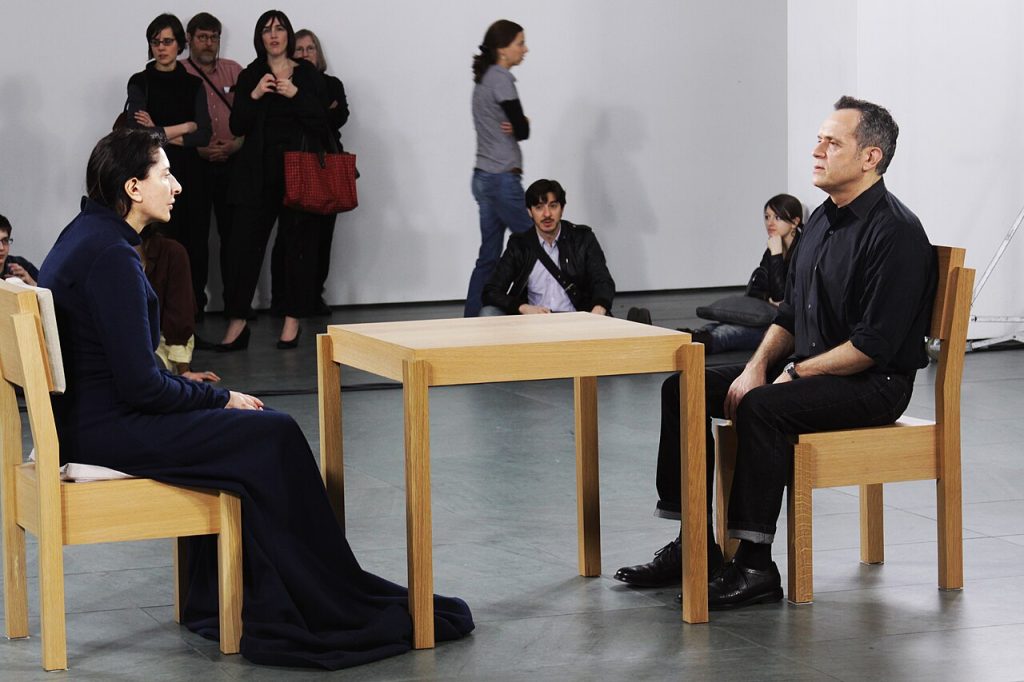
The culmination of Abramović’s career to date came with The Artist Is Present (2010), a retrospective at the Museum of Modern Art in New York that became a cultural sensation. Throughout the exhibition’s three-month run, Abramović sat silently in a chair, dressed in a long gown, as museum visitors took turns sitting opposite her in an encounter of shared presence. No words were exchanged; no physical contact occurred. The work consisted entirely of the mutual gaze between artist and participant.
The response was unprecedented. Over 1,500 people sat with Abramović during the exhibition’s duration; thousands more waited in lines that stretched for hours; millions followed the event through media coverage and online documentation. The performance attracted celebrities and ordinary citizens alike, generating an almost religious atmosphere of devotion and catharsis. Many participants wept during their silent encounter with the artist; Abramović herself often shed tears.
The Artist Is Present demonstrated that performance art could command mainstream attention without sacrificing its conceptual depth or emotional power. It also represented a significant evolution in Abramović’s practice: rather than testing her body through pain or exhaustion, she now explored the subtle endurance of attention, the intensity of silent connection, and the transformative potential of shared stillness. The work crystallized her long-standing belief that “the audience completes the work”—that performance is not a one-way transmission but an “energetic dialogue” requiring mutual presence and openness.
Later Work: Presence, Spirituality, and Expanded Practice
Following The Artist Is Present, Abramović has continued to develop her practice in new directions. 512 Hours (2014) at London’s Serpentine Galleries stripped performance to its essence: visitors surrendered their phones and watches before entering a gallery where Abramović and a team of facilitators guided them through exercises in silence and attention. There were no props, no scripted actions, no separation between artist and audience—only the shared experience of presence. The work represented a radical distillation of her core concerns, exploring “the endurance of the present moment” in an age of digital distraction.
Abramović has also expanded her engagement with photography and new media. Her Blue Period and Red Period video works from the 1970s were recently transformed into hundreds of individual photographic stills for exhibition, inviting viewers to engage frame by frame with the nuances of her gestures and expressions. This transformation of moving image into static photography exemplifies her ongoing interest in the relationship between ephemeral performance and lasting documentation.
The Abramović Method: Legacy and Critique
Abramović’s influence on subsequent generations of artists is immeasurable. Contemporary practitioners such as Tania Bruguera, whose politically charged performances interrogate power and control, and Shirin Neshat, whose explorations of gender and the gaze echo Abramović’s intensity, have all drawn inspiration from her pioneering work. Her insistence that art can be “lived, experienced, and felt on the most corporeal level” has opened possibilities for performance artists working across diverse contexts.
The Marina Abramović Institute (MAI), founded in 2013, represents her institutional legacy: a platform dedicated to preserving performance history and training future artists in durational practice. Through workshops, residencies, and public programs, MAI seeks to transmit the “Abramović Method”—a set of exercises designed to cultivate presence, focus, and endurance in both artists and participants.
Yet Abramović’s later work has also attracted critical scrutiny. Some observers question whether her emphasis on spiritual transformation and energy work has veered toward New Age mysticism at the expense of the political and social engagement that characterized her earlier practice. Some reviews of her major retrospectives have noted that works incorporating crystals and references to Tibetan Buddhist rituals risked becoming “trophies of extractive capitalism” whose “empty promise of spiritual growth” replaced the genuinely transformative potential of her earlier performances. Other critics have suggested that she has built a career repeating ideas developed in the 1970s with very little change, implying that her work has become self-referential rather than genuinely innovative.
Other critics defend her evolution, arguing that her turn toward meditative practice represents a natural progression from her early explorations of consciousness and represents a necessary adaptation to changing cultural conditions. The popularity of participatory exercises like counting grains of rice—a meditative practice developed to prepare for demanding performances—suggests that audiences continue to find value in her methods.
Conclusion: Endurance as Legacy
Marina Abramović’s five-decade career represents one of the most sustained and influential bodies of work in contemporary art. From the radical self-exposure of the Rhythm series to the collaborative investigations of her partnership with Ulay, from the political engagement of Balkan Baroque to the meditative presence of The Artist Is Present, she has consistently used her body as both subject and medium, pushing the limits of what art can be and do.
Her work embodies a fundamental belief that art should not merely represent experience but should itself be an experience—a site of transformation for artist and audience alike. As she has stated, “Joy cannot teach us anything, but pain, suffering, and obstacles can transform us, make us better, stronger, and make us realize the importance of living in the present moment.” This conviction has guided her through performances that risked her physical safety, through collaborations that tested her emotional limits, and through the evolution of her practice toward quieter forms of endurance.
Whether critiqued for repetition or celebrated for consistency, Abramović’s commitment to presence, to vulnerability, and to the direct encounter between artist and audience remains unwavering. In an era of rapid consumption and fleeting digital engagement, her insistence on slowness, attention, and shared experience seems increasingly urgent. As she herself has put it: “When death knocks at my door, I want to enter that final experience consciously and without fear.” That commitment to conscious presence—to inhabiting each moment fully, without evasion or denial—may be her most enduring legacy.
Marina Abramović has transformed performance art from a marginal practice into a central mode of contemporary expression. She has demonstrated that the body can be not only a subject for art but art itself, that vulnerability can be a form of strength, and that presence—simply being there, fully and attentively—can constitute an act of profound significance. For these contributions, and for the challenging questions she continues to pose about human limits and possibilities, she stands as a singular figure in the history of art.

No responses yet