

Table of Contents
The Labyrinth of the Gaze: Unraveling the Enigma of Velázquez’s Las Meninas
Hanging in the Prado Museum in Madrid, Diego Velázquez’s Las Meninas (The Ladies-in-Waiting), painted in 1656, is more than a masterpiece of the Spanish Golden Age; it is a cosmic singularity in the history of art, a canvas that collapses the boundaries between reality and illusion, spectator and subject, artist and sovereign. It is a painting about painting, a metaphysical inquiry into the nature of seeing and being seen. To stand before it is to be drawn into a meticulously constructed labyrinth where the gaze is both the guiding thread and the Minotaur at its center. Through its revolutionary composition, its complex play of mirrors and looks, and its profound philosophical implications, Las Meninas transcends its role as a court portrait to become a perpetual, enrapturing enigma.
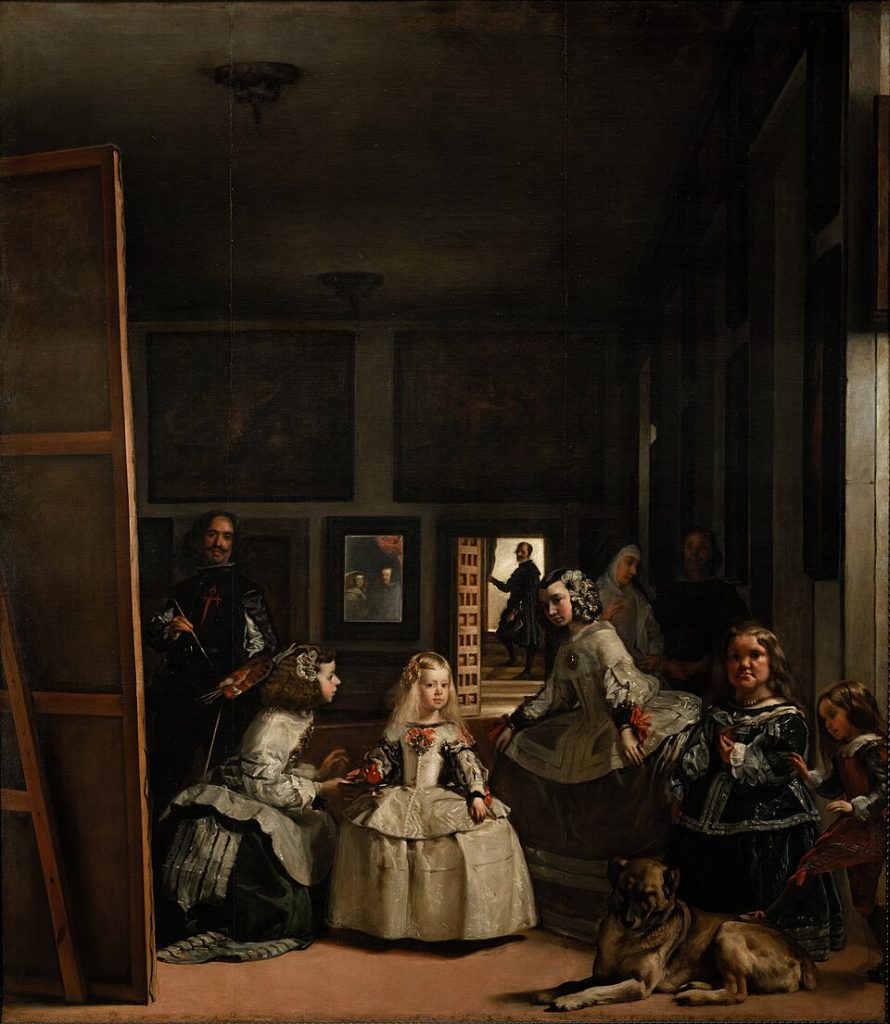
Image By Diego Velázquez – The Prado in Google Earth: Home – 7th level of zoom, JPEG compression quality: Photoshop 8., Public Domain, https://commons.wikimedia.org/w/index.php?curid=22600614
At first glance, the scene appears to be a casual snapshot of court life. We are in the high-ceilinged, spacious pieza principal of the Alcázar Palace. The central figure is the five-year-old Infanta Margarita, radiant in a white gown, flanked by her two meninas, Doña María Agustina Sarmiento and Doña Isabel de Velasco, one offering a drink of water, the other curtsying. To the right, the dwarfs Mari Bárbola and Nicolasito Pertusato, the latter playfully nudging a placid mastiff with his foot. Behind them, the chaperone Marcela de Ulloa and an unidentified guardadamas (escort) converse. In the background, a figure stands in a illuminated doorway, believed to be the chamberlain José Nieto Velázquez. And to the left, before a vast canvas, palette and brush in hand, stands the artist himself, Diego Velázquez.
This cast of characters is meticulously arranged, not randomly captured. Velázquez employs a complex spatial structure that defies the simple, single-point perspective of the Renaissance. The room recedes logically, with the figures in the foreground solid and tangible, leading the eye to the middle ground where the chaperones stand, and finally to the luminous doorway that acts as a distant vanishing point. Yet, this spatial clarity is immediately subverted by two crucial elements: the mirror on the back wall and the large canvas on the left.
The mirror reflects the blurred, but unmistakable, images of King Philip IV and Queen Mariana of Austria. This single detail transforms the entire narrative of the painting. We are not merely looking at a portrait of the Infanta; we are occupying the very space of the King and Queen. The scene we behold is the scene they are beholding. They are the presumed subjects of the large canvas on which Velázquez is working, making us, the viewers, stand in their place, seeing the world from the monarch’s perspective. This brilliant inversion makes the spectator complicit in the artwork, breaking the fourth wall nearly two centuries before the term was coined in theatre.
This leads to the central, unanswerable question: What is the subject of the painting we are looking at, and what is the subject of the canvas within the painting? Is Las Meninas a portrait of the Infanta and her entourage? Is it a painting about Velázquez painting the King and Queen, whose reflection we see? Or is it a painting about Velázquez painting Las Meninas itself? The painting refuses to settle on a single answer, creating a dizzying, self-referential loop. The large canvas on the left is turned away from us, its contents a mystery, a void around which the entire composition orbits. It is the painting’s ultimate secret, the hidden heart of the labyrinth.
Velázquez’s mastery of light further deepens the composition’s complexity. The light floods in from two sources: the main window on the right, which illuminates the Infanta and her attendants with a soft, modeling glow, and the open doorway in the background, which creates a burst of luminosity that draws the eye into the depth of the room. This masterful handling of chiaroscuro does not just define form; it orchestrates the viewer’s attention, guiding us from the brightly lit foreground to the mysterious depths of the background, where the figure in the doorway hangs in a state of ambiguity—is he entering, leaving, or simply pausing?
Beyond its compositional genius, Las Meninas is a profound social and personal statement. In the rigid hierarchy of the 17th-century Spanish court, painting was considered a craft, not a liberal art, a manual labor unworthy of nobility. Velázquez, however, spent his life aspiring to social elevation. By placing himself so prominently within a royal portrait—standing erect, confident, and wielding the tools of his trade with authority—he makes a powerful claim for the intellectual and noble status of the artist. He is not a mere servant; he is a creator, the orchestrator of this entire world, and his presence is as vital as that of the royalty he serves.
This assertion is crowned by the red cross of the Order of Santiago painted on his chest, a symbol of knighthood. Legend holds that King Philip IV himself painted it in after Velázquez’s death, acknowledging the artist’s lifelong quest for honor. Historically, Velázquez was only granted the order three years after painting Las Meninas, making its inclusion either a posthumous tribute or a bold act of wish-fulfillment by the artist. Regardless, it signifies the ultimate triumph of the painter, immortalized not just as a courtier, but as a gentleman and a virtuoso.
The philosophical reverberations of Las Meninas have only grown louder over the centuries. It is the quintessential painting for postmodern analysis, most famously by the French philosopher Michel Foucault in his seminal work, The Order of Things. Foucault argues that Las Meninas represents the classical representation of representation itself. It depicts the necessary disappearance of that which is foundational—the sovereign, the subject. The King and Queen are both present in the reflection and absent from the room, their reality contingent on a shimmer of light on a mirrored surface. The painting demonstrates that representation does not simply make the absent present, but rather organizes a system of looks and signs around a central void.
This “absence” is what gives the painting its perpetual modernity. It deconstructs the very idea of a stable, objective viewpoint. There is no single “truth” to be found in Las Meninas; there are only interconnected subjectivities. The Infanta looks out at us (or her parents). Velázquez looks out at his subjects. Mari Bárbola and Nicolasito look in various directions. The figure in the doorway looks back into the scene. And the mirror looks back at the hidden protagonists, who are also us. This network of gazes creates a web of relationships with no single center, a proto-cinematic narrative that is forever unfolding and never resolved.
The Perpetual Enigma
Las Meninas is not merely a painting to be seen; it is a problem to be solved, a philosophical proposition rendered in oil and light. Since its creation, it has commanded a unique position in the history of art, simultaneously a masterpiece of naturalism and a precursor to modern conceptualism. Its first critic, Antonio Palomino (1724), documented its figures and proclaimed its glory, setting the stage for centuries of reverence. In the 19th century, it was hailed as the pinnacle of realism. In the 20th and 21st centuries, it became a playground for theorists, philosophers, and artists who see in its complex structure a mirror to their own concerns about perception, power, and the nature of art itself. This collection of texts aims to navigate this rich history, understanding that the enduring power of Las Meninas lies in its refusal to offer a single, final meaning.
The Historical and Biographical Canvas
Chapter 1: The Court of Philip IV: A World in Twilight
To understand Las Meninas, one must first step into the twilight world of the Spanish Habsburg court. By 1656, the empire over which Philip IV presided was straining under the weight of endless wars, economic crisis, and a shrinking treasury. Yet, the court ritual remained a rigid, theatrical performance of power. The Alcázar of Madrid was not just a palace but a gilded cage, where every gesture, from a royal levée to a formal audience, was choreographed. Las Meninas captures this duality: the informal, almost casual moment of the Infanta’s visit is framed by the immense, austere room of the palace, a symbol of the unyielding structure of Habsburg authority. The painting is thus a domestic scene viewed through the lens of absolute monarchy.
Chapter 2: Diego Velázquez: From Seville to Salón de Reinos
Velázquez’s journey to painting Las Meninas was one of artistic and social ascent. Arriving at court as a young painter from Seville, he was initially classed as a mere craftsman. His ambition, however, was twofold: to refine his art and to elevate his status. His two trips to Italy exposed him to the works of Titian and the Renaissance masters, liberating his brushwork and deepening his understanding of color and light. By 1656, he was not only the King’s favorite painter but also the Palace Chamberlain (Aposentador Mayor), a position that gave him intimate knowledge of the palace’s spaces and the royal family’s private life. Las Meninas is the synthesis of this unique position: the eye of a supreme artist combined with the insider access of a high court official.
Chapter 3: The Cast of Characters: Identifying the Courtly Ensemble
Each figure in Las Meninas is a specific individual with a known history, making the painting a collective portrait.
- The Infanta Margarita: The luminous center, she is both a beloved child and a vital asset in dynastic politics, her future marriages already being negotiated to secure European alliances.
- The Meninas: Doña María Agustina Sarmiento (kneeling, offering the búcaro, a fragrant clay vessel) and Doña Isabel de Velasco (in a mid-curtsy) were noble young women tasked with her constant care. Their presence highlights the communal nature of royal upbringing.
- The Dwarfs, Mari Bárbola and Nicolasito Pertusato, and the Mastiff: Far from being mere jesters, dwarfs were permanent fixtures in European courts, often serving as loyal companions and confidantes. Their inclusion reflects the Habsburg taste for the unusual and serves to emphasize, by contrast, the Infanta’s delicate beauty and high status.
- The Chaperones: Marcela de Ulloa, a nun, and the unidentified guardadamas represent the ever-present world of protocol and supervision that governed even private moments.
- José Nieto Velázquez: The figure in the illuminated doorway is frozen in a moment of ambiguity—arriving or departing? His presence opens a passage to the world beyond the room, a glimpse of the outside and the stairs (las escaleras) he likely guards.
Deconstructing the Masterpiece: Form and Technique
Chapter 4: The Architecture of Illusion: A Spatial Analysis
Velázquez constructs his space with breathtaking audacity. He uses a one-point perspective system, but its mastery lies in how he manipulates it. The vanishing point is located near José Nieto’s hand, pulling our eye deep into the room. However, the large canvas on the left and the mirror on the back wall disrupt a simple reading. The canvas blocks our view, creating a spatial void, while the mirror projects an image from the space we, the viewers, occupy. This creates a brilliant spatial loop: the foreground is our world (the King and Queen’s viewpoint), the middle ground is the painting’s world, and the mirror reflects our world back into the painting’s world.
Chapter 5: The Alchemy of Light and Brushwork
The magic of Las Meninas is as much in its execution as in its composition. Velázquez’s technique is a form of alchemy. From up close, the painting dissolves into a dazzling array of abstract daubs and strokes of pigment—the shimmer on a sleeve, the gleam in an eye. Yet, at a distance, these strokes coalesce into perfectly rendered form and atmospheric light. He paints the air between the figures. The two light sources are key: the soft, diffused light from the right window models the figures in the foreground, while the brilliant light from the back doorway creates a focal point of depth and mystery, highlighting Nieto and framing the mirror.
Chapter 6: The Mirror and The Canvas: Engines of Metaphor
These two elements are the conceptual engines of the painting. The mirror is the key that unlocks the narrative, revealing the hidden subjects whose gaze organizes the entire scene: the King and Queen. It transforms the painting from a genre scene into a royal portrait and implicates us in their place. The large canvas, turned away from us, is the great unknown. It represents the act of creation itself, the mysterious process by which the artist transforms reality into art. Is it a portrait of the monarchs? Or is Velázquez, in a moment of stunning self-reference, painting the very scene we are looking at? The painting thrives on this unresolvable ambiguity.
Philosophical and Theoretical Interpretations
Chapter 7: Foucault’s Las Meninas: Representation and Its Discontents
Michel Foucault’s 1966 analysis was a watershed moment. He argued that Las Meninas is the perfect illustration of “classical representation”—it is a painting about the very act of representing. He points to the central void where the King and Queen should be, arguing that representation is organized around an absence. The artist looks out, the Infanta and her retinue look out, but the true subject (the sovereign) is only present as a reflection, a derivative image. For Foucault, the painting demonstrates that representation makes the subject disappear even as it seeks to depict it, a fundamental paradox of the classical age.
Chapter 8: The Politics of the Gaze
A modern reading of Las Meninas examines the power dynamics embedded in its network of looks. The gaze is not neutral. The royal gaze (from the mirror) is the most powerful, structuring the entire scene. Velázquez’s gaze is one of authority and control. The Infanta and her maids look out, seeking approval. The dwarfs and the dog are largely objects of the look, not initiators of it. This hierarchy of vision reflects the rigid social order of the court. Furthermore, the inclusion of the marginalized figures (the dwarfs) invites a post-colonial reading, considering Spain’s vast empire and the “othering” of those who did not fit the standard of nobility.
Chapter 9: The Artist’s Triumph: Velázquez’s Self-Fashioning
In no other major court portrait is the artist so prominently and confidently displayed. Velázquez paints himself not as a servile craftsman, but as a gentleman, a virtuoso in his studio, holding the tools of his trade like a scepter. The ultimate affirmation is the red cross of the Order of Santiago on his chest, a symbol of knighthood. While he was not granted this honor until 1659 (three years after the painting was done, and legend says painted by the King himself), its inclusion—whether anticipatory or posthumous—is the final argument. In Las Meninas, Velázquez successfully refashions himself from a manual laborer into a noble creator, forever securing the dignity of the artist.
Legacy and Influence
Chapter 10: The Ghost in the Mirror: Las Meninas in Later Art
No other painting has been so obsessively quoted, deconstructed, and homage by later artists.
- Pablo Picasso: In 1957, he locked himself in his studio and produced 58 versions of Las Meninas, exploding its form into Cubist components. He wasn’t copying; he was having a conversation with Velázquez, exploring the painting’s structural DNA.
- Francisco Goya: As a court painter a century later, Goya felt Velázquez’s shadow. His Family of Charles IV is a direct descendant, but its unflinching, almost critical realism shows a different, more disillusioned view of monarchy.
- Salvador Dalí: He created surrealist versions, fascinated by its metaphysical puzzles, elongating forms and placing the figures in dreamlike landscapes.
- Contemporary Artists: Artists like Eve Sussman (The Rape of the Sabine Women) and photographers like Joel-Peter Witkin have re-staged it, using its iconic composition to explore contemporary themes of surveillance, identity, and the artifice of images.
In conclusion, Las Meninas is a work of unparalleled genius that operates on multiple, simultaneous levels. It is a supreme technical achievement, a snapshot of Spanish court life, a manifesto for the dignity of the artist, and a deep philosophical treatise on vision and knowledge. Velázquez did not merely paint a picture; he constructed a visual machine designed to provoke thought across centuries. It invites us into its space, assigns us a role, and then questions the very nature of that role. It is a painting that holds a mirror not just to the King and Queen of Spain, but to the act of perception itself, asking us, the viewers, who we are in this complex play of appearances. In the silent, luminous chamber of Las Meninas, we are all, like the figures within it, both observers and participants, forever caught in the labyrinth of the gaze.

No responses yet