
Table of Contents
The Unseen Splendor: Art and Symbolism of the Gnostic Christians
Introduction: Seeking the Spark in the Shadows
The term “Gnostic Christians” refers to a diverse array of early Christian groups flourishing between the 2nd and 4th centuries AD, united by a core belief in gnosis (Greek for “knowledge”)—not intellectual understanding, but a revelatory, saving knowledge of the divine. For them, the material world was not the perfect creation of the supreme God but the flawed, often malevolent, work of a lesser deity or demiurge. Humanity, however, carried within a divine spark, a fragment of the transcendent true God, trapped in the prison of the flesh and cosmos. Salvation lay in awakening to this inner divinity and transcending the material realm.
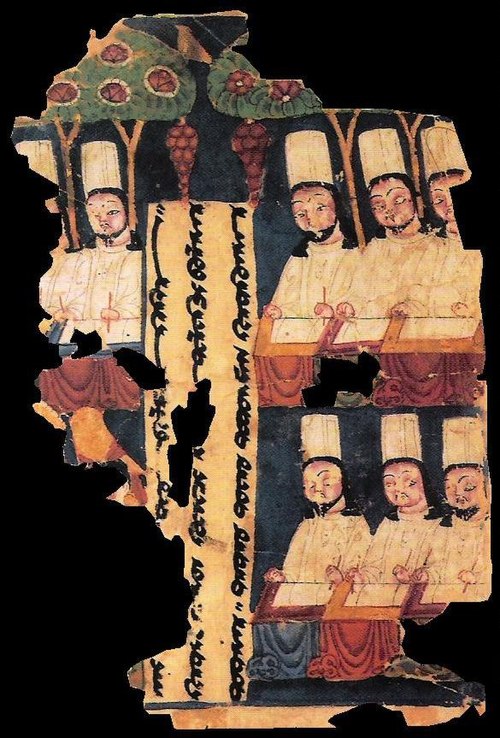
Image: By Unknown author – The original description page was here. All following user names refer to en.wikipedia., Public Domain, https://commons.wikimedia.org/w/index.php?curid=612067
This radical theology posed a profound challenge: how does one represent, through material means (paint, stone, text), a faith that fundamentally distrusted matter and the visible world? The Gnostics did not leave behind grand cathedrals or a clearly defined canon of public art. Their “art” was inherently paradoxical, often symbolic, textual, and interior. It was an art of the mind and the secret revelation, designed not to adorn but to instruct, encrypt, and ultimately liberate. This essay explores the multifaceted artistic expressions of Gnostic Christianity, examining their symbolic language, their relationship with broader early Christian and pagan art, and their enduring legacy in the realms of cosmology and the pursuit of hidden truth.
I. The Theological Foundation: A Worldview Hostile to Representation
To understand Gnostic art, one must first grasp its theological constraints. The Platonic disdain for the sensible world was radicalized in Gnostic thought. The demiurge—often identified with the Yahweh of the Old Testament—was ignorant, boastful, and sometimes openly malicious. The cosmos he crafted was a system of illusion, a labyrinth of planetary spheres (Archons) guarding the soul’s ascent. Consequently, traditional iconic representation of a creator God or a celebratory art of nature was problematic. How could one glorify the prison?
Thus, Gnostic expression favored:
- Symbolism over Literalism: Direct depiction was often avoided in favor of dense, multivalent symbols that pointed beyond themselves.
- Abstraction and Diagram: The mapping of spiritual realms (pleroma, aeons) lent itself to schematic, almost diagrammatic representations.
- The Primacy of the Text: The container of gnosis was most frequently the written word—copied, studied, and decorated—as the direct vehicle for revelation.
- Interiority: The true “artwork” was the awakened self, the reformed psyche. Ritual and contemplative practice were the performative art of liberation.
II. The Nag Hammadi Library: Manuscripts as Sacred Artifacts
Our most significant cache of Gnostic art is not fresco or sculpture, but a collection of codices: the Nag Hammadi Library, discovered in Egypt in 1945. These Coptic-language manuscripts from the 4th century are themselves artifacts of artistic and devotional labor.
- The Codex as Vessel: The very form of the book—a codex, not a scroll—was a relatively new technology adopted by early Christians and Gnostics alike for its utility and portability. It became the physical vessel for hidden wisdom.
- Colophons and Scribal Art: While not lavishly illuminated like medieval gospels, some texts feature colophons—scribal notes at the end—that are artistic statements. The most famous is at the end of The Apocryphon of John in Codex II, which reads: “This writing is the treasure of immortality. Peace to the scribe and the readers!” The act of copying was a devotional, salvific act. The careful, uniform script is an art of discipline, preserving the precise words that could trigger gnosis.
- Frontispiece Symbolism: Codex II begins with a simple but potent design: a double-bordered rectangle enclosing the titles of the texts. This can be interpreted as a symbolic representation of the bounded cosmos, the kenoma (void), within which the titles—the seeds of gnosis—are contained, waiting to break through to the reader’s understanding. The manuscript itself becomes a microcosm of the soul’s journey from confinement to enlightenment.
III. Symbolic Motifs: A Lexicon of Liberation
Gnostic art, where it appears, is a tapestry of recurring symbols, each rich with theological meaning:
- Light and Darkness: The most fundamental dichotomy. The divine spark is a “luminescence,” a “ray of light” trapped in the “darkness” of matter. Artistic depictions (as seen later in related movements like Manichaeism) emphasize this contrast.
- The Serpent: A profoundly ambivalent symbol. While mainstream Christianity saw the serpent as the tempter, many Gnostics revered it as the bringer of gnosis (cf. The Secret Book of John), who urged Adam and Eve to eat from the Tree of Knowledge and thus rebel against the ignorant demiurge. This positive serpent (Ouroboros sometimes) symbolizes transformative wisdom.
- The Divine Feminine: Gnostic texts abound with female aeons and symbols of the feminine divine: Sophia (Wisdom), the fallen aeon whose yearning gives rise to the material world and whose restoration is key to salvation; Barbelo, the first emanation of the Invisible Father; and Helen, the companion of the Gnostic teacher Simon Magus, seen as the embodied Ennoia (Thought) of God. This provided a theological space for female imagery and authority largely marginalized in proto-orthodox circles.
- Pearls, Sparks, and Seeds: Common metaphors for the divine soul-fragment within. The Hymn of the Pearl, from the Acts of Thomas, is a masterful allegorical narrative of a prince sent to Egypt to retrieve a pearl from a serpent, symbolizing the soul’s descent, forgetfulness, and ultimate recall of its royal origin.
- The Alien: A key concept is the “alien” or “stranger” status of the believer. The saved are “not of this world.” This could translate artistically into motifs of exile, journey, and heavenly garments (stripping off the material body).
IV. Dialogue and Dissonance with Mainstream Early Christian Art
Gnostic groups existed in tension and dialogue with the developing Christian mainstream. This is reflected in artistic themes:
- Shared Motifs, Divergent Meanings: Both used symbols like the fish (Ichthys), the anchor (hope), and the good shepherd. For Gnostics, however, the good shepherd (often a youthful, beardless Christ) didn’t just care for souls; he specifically rescued the lost sparks from the archontic powers, leading them out of the cosmic fold.
- The Crucifixion: A point of stark divergence. For many Gnostics (like the Docetists), Christ, as a pure emanation of the high God, could not truly suffer in material flesh. His humanity was an illusion. Therefore, the crucifixion was not a sacrificial atonement but a revelation of the illusory nature of material suffering, or a defeat of the archons through cunning. Depictions of the crucifixion, if they existed, would likely emphasize Christ’s triumph and impassibility, not his agony.
- The Redeemed Redeemer: A central Gnostic myth tells of a divine being (often the Christ) who descends through the planetary spheres, disguising himself from the Archons, to awaken Sophia and humanity. This descending-ascending savior, reconstructing the disrupted pleroma, is a narrative more suited to cosmological diagrams than to historical narrative scenes.
V. Legacy and Influence: From Heresy to Hermetic Resonance
Though declared heretical and suppressed by the 4th century, the artistic and symbolic legacy of Gnosticism proved tenacious.
- Manichaeism: This later, highly organized Gnostic religion founded by Mani (3rd cent. AD) developed a rich artistic tradition, as seen in fragments from Central Asia, employing elaborate cosmogonic diagrams and beautifully illuminated manuscripts that made stark, symbolic use of light and dark imagery.
- Medieval Heresies and Esotericism: Gnostic themes resurfaced in the symbolism of the Cathars and Bogomils, for whom the world was the creation of Satan, and pure spirit was to be freed. Their art, largely lost due to persecution, would have been austere, rejecting material splendor.
- Modern and Contemporary Art: The Gnostic worldview—with its alienation from a flawed material reality, its quest for hidden knowledge, and its tragic, luminous cosmology—has deeply influenced modern thinkers (Jung, Eco, Philip K. Dick) and artists. The surrealists’ interest in dream symbolism and alternative realities; the abstract expressionists’ pursuit of primal, spiritual truths beyond representation; and the cyberpunk genre’s themes of reality-as-simulation and liberating data—all echo core Gnostic preoccupations. Artists like William Blake, with his rebellious demiurge Urizen and emphasis on imaginative perception over sensory captivity, can be seen as a proto-Gnostic visionary.
Conclusion: The Art of the Invisible
The art of the Gnostic Christians is ultimately an art of the invisible. It finds its purest expression not in pigment or stone, but in the architecture of myth, the calligraphy of revelation, and the internal iconoclasm of the seeking soul. It is an art that uses the materials of a despised world to point relentlessly beyond it. In their manuscripts, we see the book become a cosmos and a tool for escape. In their symbols—the serpent of knowledge, the pearl of soul, the alien light—they crafted a visual and conceptual lexicon for spiritual dissent and transcendental yearning.
While they left no Sistine Chapel, their legacy is the enduring artistic power of the idea that the visible world is a coded text, and that true art, like true gnosis, involves breaking the code to perceive the unseen splendor within. In an age saturated with images, the Gnostic invitation to look through the material, to seek the spark encrypted in the darkness, remains a potent and challenging artistic principle.

No responses yet