

Table of Contents
The Sanctum of Self: An Exploration of Bedchamber Aesthetics
The bedchamber, in its most fundamental form, is a place of primal necessity: a site for sleep, for rest, for vulnerability. Yet, to consider it merely a functional space is to overlook its profound role as the most intimate canvas of the self. Bedchamber aesthetics—the deliberate cultivation of atmosphere, style, and sensory experience within the sleeping quarters—transcends simple decoration. It is a personal philosophy, a non-verbal autobiography, and a critical tool for psychological and physical well-being. This essay will explore the historical evolution of the private sleeping chamber, deconstruct the core principles of its aesthetic creation, and argue for its reclamation as a vital sanctuary in the modern world.
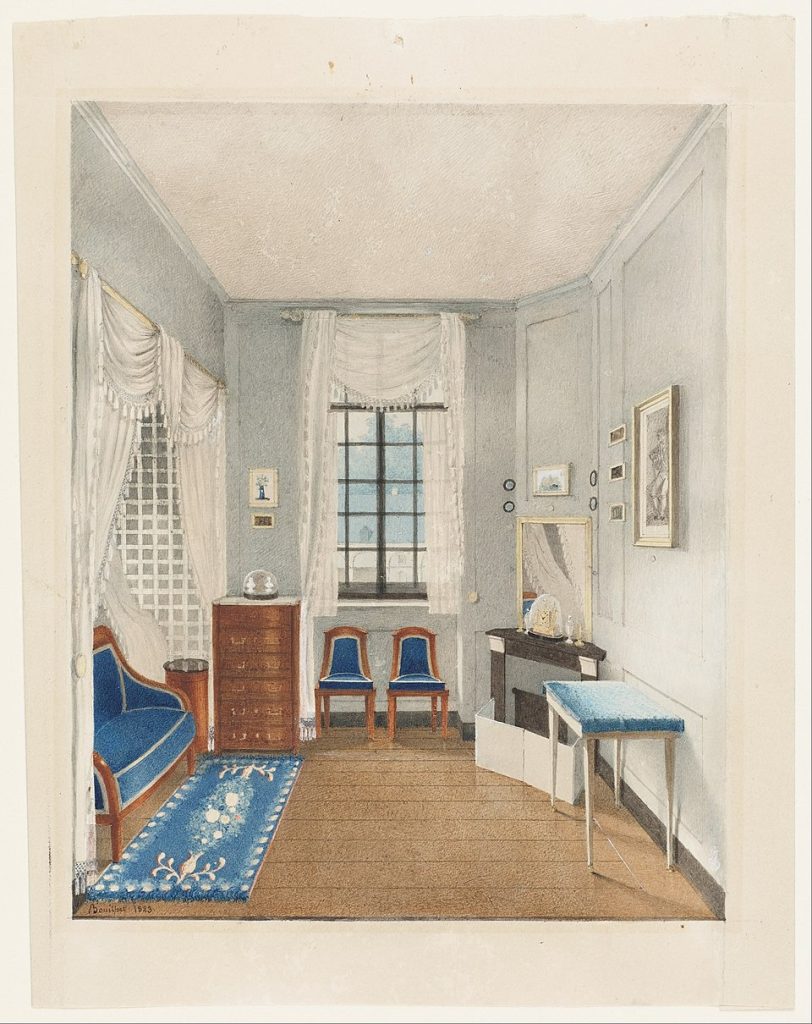
Image: By Bouilhet – DQHnRqh1K-xdAQ at Google Cultural Institute maximum zoom level, Public Domain, https://commons.wikimedia.org/w/index.php?curid=21908024
I. A Brief Historical Tapestry: From Communal Hall to Private Haven
To appreciate the modern bedchamber’s aesthetic potential, one must understand its journey from public to private space.
- The Pre-Modern Chamber: Power and Display. In medieval and Renaissance Europe, the bedchamber of the elite was often a semi-public room, a stage for political ceremony (the lever and coucher of French kings), demonstrations of wealth through heavy fabrics (velvets, brocades), and familial legacy via heraldic motifs. The bed itself was a monumental symbol, canopied for warmth and privacy within draughty castles. Aesthetics served status and survival, not introspection.
- The Birth of Privacy and Intimacy. The 17th and 18th centuries saw the gradual retreat of the bedroom from public life, particularly among the burgeoning middle class. Influenced by ideas of privacy, conjugal intimacy, and individual comfort, the chamber became smaller, warmer, and more personalized. The rise of the novel and letter-writing, often done in bed or in a boudoir, cemented the room’s association with interiority. Rococo aesthetics introduced softer lines, pastoral themes, and a more delicate palette, reflecting a shift towards personal pleasure.
- The Victorian Dichotomy: Morality and Clutter. The 19th-century bedchamber embodied a tension between oppressive morality and material abundance. Rooms were often dense with symbolic clutter—heavy drapes, mahogany furniture, myriad tchotchkes—meant to convey solidity and virtue. Yet, this was also the era of the “boudoir” (from the French bouder, to sulk), a woman’s private sitting room attached to the bedchamber, which became a rare space for limited autonomy and self-expression, often featuring softer textiles, personal collections, and writing desks.
- Modernist Purification and Contemporary Pluralism. The 20th century reacted violently against Victorian clutter. Modernist pioneers like Le Corbusier and the Bauhaus movement championed the bedroom as a “machine for sleeping”: clean, sterile, minimal, and functional. This purgation opened the door for today’s pluralism. We now curate our chambers from a global palette of styles—Scandinavian hygge, Japanese wabi-sabi, Bohemian eclecticism, minimalist sparsity—reflecting a postmodern understanding of identity as fluid and self-constructed.
II. The Pillars of Bedchamber Aesthetics: Crafting the Sensory Cocoon
Contemporary bedchamber aesthetics rests on several interdependent pillars, each addressing a different facet of human sensation and psychology.
1. The Chromatic Soul: Colour Psychology and Palette
Colour is the most immediate emotional trigger. The bedchamber palette must prioritize restoration.
- Serene Foundations: Soft, muted, and low-chroma colours dominate—whispering blues (tranquility), sage greens (balance), cloud-like greys (neutral calm), and warm, earthy neutrals (security). These hues lower physiological arousal, preparing the mind for sleep.
- Accents of Identity: Pops of deeper or more vibrant colour—a burnt orange cushion, a framed artwork with maroon strokes, a navy velvet throw—are strategically placed to express personality without overwhelming the senses. They serve as visual anchors of joy or passion.
- The Depth of Darkness: Embracing darker shades on walls or ceilings can create a profound, womb-like sense of enclosure and intimacy, challenging the ubiquitous expectation of all-white “airiness.”
2. The Textile Landscape: Tactility and Layering
If colour speaks to the eyes, textiles speak to the skin, our largest organ. Bedchamber aesthetics is profoundly haptic.
- The Stratigraphy of the Bed: The bed itself is a lesson in complex layering: crisp percale sheets (cool and structured), a breathable wool or down duvet (weighted comfort), a textured knit throw (tactile interest), and pillows of varying firmness and size. This invites ritual and offers seasonal adaptability.
- Ambient Textures: A chunky wool rug underfoot on a cold morning, linen curtains diffusing morning light, the smooth grain of reclaimed wood on a nightstand—these varied surfaces create a rich tactile environment that grounds and comforts.
3. The Choreography of Light: Illumination as Atmosphere
Lighting is the director of the room’s mood across the diurnal cycle.
- Non-Visual Awareness: Prioritizing warm-toned (2700K or lower) bulbs is essential, as cool blue light inhibits melatonin. Dimmers are non-negotiable, allowing a gradual descent from wakefulness to sleep.
- Layered Lighting Strategy: Overhead lights are often the enemy of atmosphere. A successful scheme relies on layers: ambient (a low-floor lamp), task (focused reading light), and accent (a small LED behind a headboard or under a shelf). Candlelight (real or simulated) remains unmatched for its primal, flickering warmth.
4. The Curation of Objects: Meaning Over Mass
The principle of “nothing in here that does not soothe or speak to you” is paramount.
- Intentional Curation: Every object should earn its place—a small gallery of cherished art or photographs, a single piece of sculptural driftwood, a well-loved book stack, a fragile heirloom on the dresser. This is anti-clutter; it is the mindful assembly of a personal museum.
- The Scented Dimension: Often overlooked, scent is a direct pathway to memory and emotion. Aesthetics can be olfactory: the subtle, consistent use of a lavender linen spray, a high-quality cedarwood candle, or the natural aroma of essential oils in a diffuser (lavender for sleep, eucalyptus for clarity).
5. The Architecture of Space: Flow, Void, and Prospect
The arrangement of space itself is aesthetic.
- The Sanctuary Layout: Furniture is arranged to promote flow and a sense of safety, often with the bed positioned to have a clear view of the door (a subconscious “prospect-refuge” instinct). Clear floorspace around the bed enhances a feeling of openness and ease.
- The Embrace of Void: Negative space—an empty corner, a blank wall, a clear surface—is not wasted space. It is visual respite, allowing the eyes and mind to rest, and is a core tenet of Japanese-inspired aesthetics.
III. The Deeper Why: The Bedchamber as a Critical Sanctuary
The pursuit of this aesthetic is not mere indulgence. It is a form of self-care and identity preservation with profound implications.
- A Bulwark Against the External World: In an era of constant connectivity, digital intrusion, and performative social spaces, the bedchamber becomes the last truly private frontier. Its curated aesthetics create a symbolic and sensory barrier, a “soft cell” that keeps the chaos and demands of the outside world at bay.
- The Theater of the Self: Here, one is not a employee, a consumer, or a public persona. The aesthetics of the room reflect internal states, memories, and aspirations unseen by others. It is where one can be literally surrounded by one’s own taste, history, and comfort, reinforcing a stable sense of self.
- Neurological and Psychological Reset: Aesthetically calibrated environments directly impact nervous system regulation. The harmonious, predictable, and sensory-soothing space lowers cortisol, encourages the parasympathetic (“rest and digest”) state, and facilitates the critical psychological functions of sleep and dream integration. It is a tool for mental health maintenance.
Conclusion: The Well-Made Haven
Bedchamber aesthetics, therefore, is far more than matching pillows to duvet covers. It is the deliberate and artistic construction of a haven—a sensory cocoon tailored to the individual’s deepest needs for rest, safety, and identity. It draws from a long history of the room’s evolution from public stage to private retreat, and it employs a sophisticated language of colour, texture, light, and object to speak directly to the subconscious.
In cultivating this sanctum of the self, we do not merely decorate a room; we actively compose the environment for our most vulnerable hours, ultimately crafting a foundational space from which a more centered, resilient, and authentic self can emerge each day. The well-made bed, within the well-considered room, is indeed the starting point for a well-lived life.

One response
[…] The Art Nouveau movement (c. 1890-1910) emerged as a comprehensive stylistic rebellion against the historicism and academic rigidity of the 19th century. Seeking a new visual language for a new age, its proponents drew inspiration from the organic forms of the natural world, synthesizing them with modern materials and a unifying design philosophy. While the style manifested in everything from jewellery to metro entrances, its application to theatre architecture and design represents one of its most complete and spectacular triumphs. The Art Nouveau theatre was not merely a building for performance; it was itself a total work of art (Gesamtkunstwerk), an immersive aesthetic experience that began at the façade and culminated in the spectacle on stage. […]