

Table of Contents
The Stone Eternity: An Exploration of Ancient Egyptian Sculpture
Introduction: Art for Eternity
Ancient Egyptian sculpture stands as one of the most distinctive, consistent, and spiritually profound artistic traditions in human history. Spanning over three thousand years—from the Predynastic Period (c. 6000–3150 BCE) to the Roman conquest (30 BCE)—this monumental body of work was not created primarily for aesthetic admiration, but served as a vital conduit between the earthly and divine realms, the living and the dead.
Governed by a complex system of religious beliefs, conventions, and symbolic requirements, Egyptian sculptors produced works that combined idealized form with profound symbolic content, creating what Egyptologist Cyril Aldred termed “stone embodiments of eternal truths.” This essay will examine the functional purposes, stylistic conventions, materials and techniques, historical evolution, and lasting legacy of ancient Egyptian sculpture.
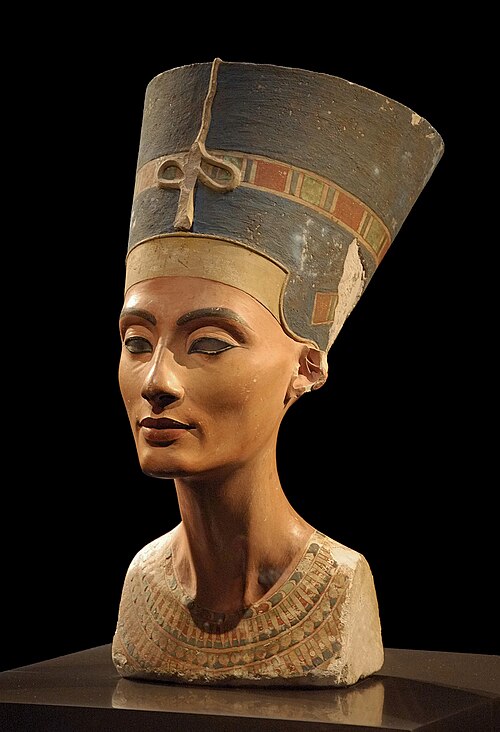
Photo: By Philip Pikart – Own work, CC BY-SA 3.0, https://commons.wikimedia.org/w/index.php?curid=8433730
I. Functional Purposes: Sculpture as a Vessel for the Ka
Unlike the largely secular art of later Western traditions, Egyptian sculpture served specific religious and ritual functions central to the culture’s worldview.
Funerary Context: The primary function of sculpture was to provide a permanent dwelling place for the ka (the life-force or spiritual double) should the mummified body decay. Statues placed in serdabs (sealed statue chambers) in tombs, like the sublime seated figure of King Djoser from the Third Dynasty, served as alternative vessels for the soul. This “replacement body” ensured the deceased’s existence in the afterlife.
Cult and Temple Context: Temples housed cult statues of deities, often kept in darkened sanctuaries and attended by priests. These were not objects of public worship but believed to be literal habitations of the god’s presence. Royal sculptures at temple entrances (like colossal statues and pylons) communicated the pharaoh’s divine role as intermediary between gods and people.
Political and Propaganda Functions: Sculpture reinforced state ideology and the pharaoh’s absolute authority. Colossal statues at temple complexes (such as Ramesses II at Abu Simbel) projected power, stability, and the ruler’s superhuman status. Standardized royal portraits distributed throughout the kingdom affirmed the pharaoh’s omnipresence.
II. Stylistic Conventions and the Canon of Proportions
Egyptian sculpture followed a strict set of conventions that remained remarkably consistent for millennia, emphasizing clarity, completeness, and idealized permanence over transient realism.
Frontality and Axiality: Most statues are conceived with a strict frontal orientation, designed to be viewed from the front. An invisible vertical axis divides the figure symmetrically, creating a sense of solemnity and immovable presence.
The Law of Frontality: In relief sculptures and paintings, figures are rendered in composite view: head and legs in profile, eye and torso frontal. This convention allowed for the clearest, most complete representation of the human form according to Egyptian perceptual principles.
Idealism vs. Realism: Royal and elite sculpture typically presented an idealized, ageless, and perfect form, reflecting the subject’s divine or perfected state. Exceptions appear during periods like the Amarna Period, and in some private, older, or non-elite statues where more naturalistic features appear.
Hierarchy of Scale: Size indicated relative importance. Gods are larger than pharaohs, who are larger than officials, who are larger than servants and children. This is vividly seen in group statues and relief compositions.
The Canon of Proportions: A detailed grid system governing human proportions was used from the Old Kingdom onward. This mathematical framework ensured consistency and idealized form, dividing the body into 18 or 21 units from hairline to sole, with key anatomical points falling on specific lines.
III. Materials, Techniques, and Craftsmanship
The choice of material carried symbolic meaning, and the Egyptians mastered extremely hard stones with simple but effective tools.
Symbolic Materials:
- Granite and Diorite: Hard stones from Aswan, symbolizing eternity and durability, used for royal and divine statues.
- Limestone and Sandstone: Softer, more abundant, often painted.
- Quartzite: Associated with the sun god Ra, favored for royal sculpture in the New Kingdom.
- Wood: Often painted, used for private statues; less durable but allowed for more dynamic forms.
- Copper, Bronze, and Gold: Used for cult statues and royal figures, symbolizing the flesh of the gods (gold represented the skin of deities).
Techniques: Sculptors used stone pounders, copper and bronze chisels, and drills with abrasive sand. Statues were often carved from a single block. A master sculptor would create a preliminary sketch, then teams of artisans would rough out and finish the work. Most sculpture was originally painted—skin tones (reddish-brown for men, lighter yellow or pale for women), clothing, and regalia in symbolic colors.
IV. Historical Evolution: Continuity and Innovation
While conventions remained, distinct stylistic shifts mark Egypt’s long history.
Early Dynastic and Old Kingdom (c. 3000–2181 BCE): Establishment of canonical forms. The peak of royal portraiture combining idealism with subtle individuality: the Great Sphinx (Giza), the serene majesty of King Khafre, and the lifelike limestone statue of Ka-Aper (“Sheikh el-Beled”).
Middle Kingdom (c. 2055–1650 BCE): A period of expressive psychological depth. Royal faces show care, anxiety, and world-weariness, reflecting the period’s political turmoil, as seen in the somber portraits of Senwosret III and Amenemhat III.
New Kingdom (c. 1550–1069 BCE): Imperial grandeur and refined elegance. Profusion of colossal statues and temple reliefs. Distinct styles under each dynasty: elegant realism under Hatshepsut and Thutmose III; monumental power under Amenhotep III; the revolutionary naturalism of the Amarna Period under Akhenaten, with its elongated forms and intimate domestic scenes; and the return to idealized, massive forms under Ramesses II.
The Amarna Interlude (c. 1353–1336 BCE): A radical departure under Akhenaten. Figures were depicted with elongated heads, slender limbs, protruding bellies, and realistic familial interaction. The famous bust of Nefertiti exemplifies a blend of stylization and breathtaking naturalism unique in Egyptian art.
Late Period and Ptolemaic (664–30 BCE): A revival of archaic styles, archaism as a form of cultural assertion against foreign rule. Increased technical virtuosity but often with a stiff, formal quality. Synthesis of Egyptian and Greek styles under the Ptolemies.
V. Iconic Masterpieces and Their Significance
The Great Sphinx of Giza (Old Kingdom): The ultimate symbol of royal power and wisdom, combining the body of a lion with the head of King Khafre, guarding the Giza plateau.
Statue of Khafre Enthroned (Old Kingdom): Embodies divine kingship through perfect symmetry, interlocking of figure and throne, and the protective Horus falcon behind his head.
Seated Statue of Hatshepsut (New Kingdom): A female pharaoh depicted in male regalia, asserting legitimate rule through traditional canonical form.
Bust of Nefertiti (Amarna Period): A masterpiece of painted limestone, capturing idealized beauty with lifelike refinement and elegant color.
Colossal Statues of Ramesses II at Abu Simbel (New Kingdom): Epitome of royal propaganda, designed to awe subjects and symbolize the pharaoh’s eternal vigilance.
VI. Legacy and Influence
The rediscovery of Egyptian sculpture following Napoleon’s 1798 expedition ignited Egyptomania in the West, profoundly influencing Neoclassical art and design. Its geometric clarity and timeless stillness inspired 20th-century modernists like Constantin Brâncuși and Henry Moore. More fundamentally, Egyptian sculpture represents humanity’s most sustained attempt to visually conquer mortality, to give permanent stone form to the hope of life beyond death. In its solemn frontality, idealized forms, and monumental scale, it sought not to capture a fleeting moment, but to create an eternal presence.
Conclusion: The Enduring Presence
Ancient Egyptian sculpture was a sacred technology for immortality. Its enduring power lies not in anatomical accuracy or dynamic movement, but in its profound embodiment of a cultural worldview—one that valued order (ma’at), permanence, and the eternal continuum between the human and the divine.
Through granite and limestone, Egyptian sculptors fixed the essence of their subjects for eternity, creating a stone hymn to the enduring human spirit. As we stand before these serene countenances millennia later, we still engage in the silent dialogue they were designed to inspire—across the abyss of time, reminding us of humanity’s perennial yearning for transcendence and permanence. In their immutable stillness, they speak most eloquently of what it means to confront eternity.

No responses yet